
Will America Ever Care About Electric Cars?
If they’re as sleek and affordable as the Tesla Model 3, it looks like the answer is yes.
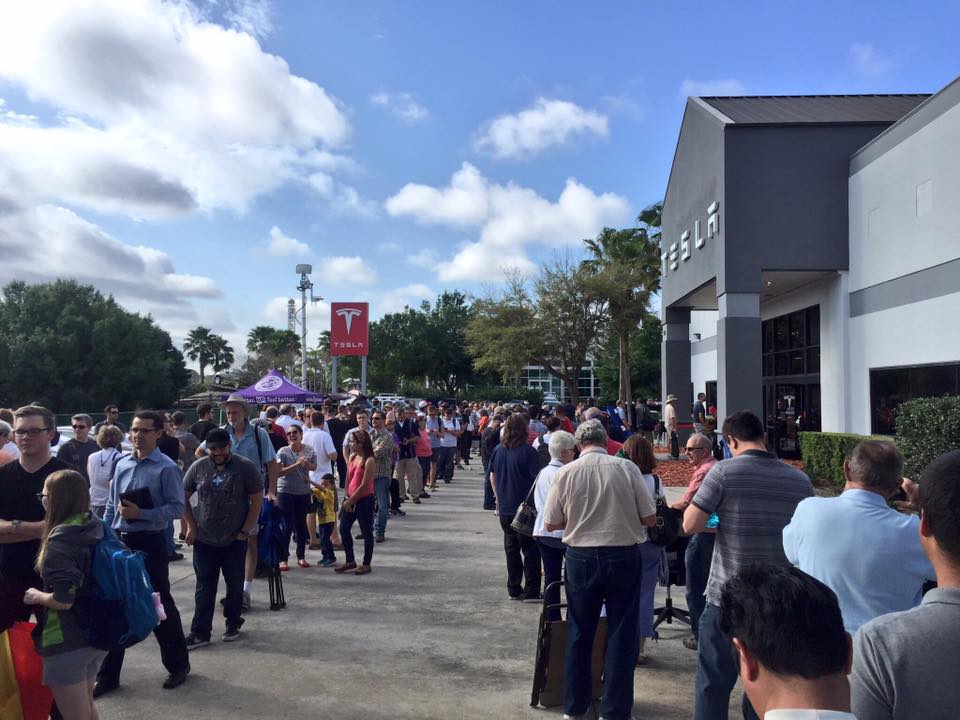
Yesterday was the long awaited day that Tesla Motor’s Model 3 became available for preorder. Customers had to come in-person to a Tesla dealership to place their preorder, and it appears that was not a deterrent, with lines at many dealerships reaching into the hundreds, just to be higher up the list. Before any consumer has driven one, the car has received over 133,000 orders on day one, despite the fact that the first cars won’t be delivered until late 2017 at earliest.
From a company that delivered less than 51,000 cars last year, it’s clear that Tesla will have to ramp up their American production to satisfy the demand. It’s also shown that if you give the consumer something that they want – in this case a car that can travel up to 215 miles on a single charge, fit five adults, have two trunks since there’s no need for a messy engine and support systems in the front hood, and make you look super cool – they will change habits. It’s not that (most) people love going to the gas station, it’s that there hasn’t been a viable alternative that wasn’t exorbitantly priced. But for $35,000 (slightly over the median new car cost of $33,560), Tesla is offering an attractive way into the future of lessened dependence on oil and emissions. Maybe that factors in when some people buy, or maybe they just like the idea of lower maintenance and fueling costs, as well as a reasonably priced status symbol, like the early iPod or iPhone compared to other music players and smartphones.
You might think that this economic shift would piss current winners off, and you’d be right. Green Car Reports has a handy infographic for which states you can buy direct from Tesla in, and for fun, they’ve included a map of average margins of presidential victories over the past two decades, which just so happens to match up fairly well. The argument in some states is that it should be illegal for auto manufacturers to sell directly to consumers, and instead should be forced to go through third-party dealerships. Somehow this duality exists within the same margins that vote down spending deemed wasteful and government positions seen as useless bureaucracy. But hey, it’s different when it’s a company that wants to sell it’s product to it’s clients and not deal with someone who wants a cut for literally no reason.
Apps can filter out your dates by political party—but that doesn’t mean you should let them
Jake Flanagin, Quartz
Would you choose who you date based on their political leanings? It appears in general no, unless you happen to support Donald Trump and are open to sharing that up front. In which case, expect a lot of swipes left.
Dating app Bumble has added the ability to list who you are voting for, and to be able to filter other users based on this information. While it may matter to some users, adoption isn’t high, and interviews with some users indicate that they want to be open to people with different viewpoints than their own, especially if they are more moderately leaning.
Netflix’s Grand, Daring, Maybe Crazy Plan to Conquer the World
Brian Barrett, Wired
What happens when one company controls content creation as well as distribution? Old movie studios used to know this, and Netflix is the leader of the breed of new tech companies that are learning how to handle production and delivery in a long chain from idea inception to viewers eyes. Thanks to the enormous amounts of data that can be collected and quantified, such as which of the character shots from season two of DareDevil get users to click and view the show most reliably, they can finely tune a machine that delivers what you want as entertainment, when you want it. Without the pesky distribution rights contracts, shows like Daredevil, Orange is the New Black, Bojack Horseman, and House of Cards can be made and then used however Netflix wants. While there is still plenty of space for old fashioned production companies, their all-encompassing power has slowly been eroding, allowing Netflix, Hulu, Amazon Prime and similar video distributors to claim more and more bandwidth and view time.
One in five employees would sell their work passwords, some for less than $100
Joon Ian Wong, Quartz
Most cases of hacking don’t come through brute force attacks or sophisticated technical schemes, but simple social engineering. A survey by software management firm SailPoint asked employees at companies with over 1,000 headcount (also known as more valuable targets) if they would sell their passwords. Globally, around 20% of those surveyed said that they would, for an average value of $82,000. Additionally, two thirds of respondents confirmed that they reuse the same password for multiple company accounts, and one third already shared passwords with coworkers.
Leave a Reply