Category: Newsletter

  • This Week in Web #8

    Apple, the FBI, and Cyber Security

    Enough bytes have been downloaded from screen to encrypted screen about the legal battle between Apple and the FBI. It was the lead story in This Week in Web #7, and it is still the top tech news dominating the week. Op-eds will continue to rightfully point out that it’s not a dichotomy of privacy vs. security, while the FBI and CIA will be quick to point fingers, with the director of the latter pointing specifically at the media for misleading the public on the audacity of reporting on newsworthy stories about our rights while cheering for the terrorists to win. Does that make me an accessory to this crime? Do I consider myself journalistic enough to have a dog in this fight? Maybe give it some time, but I doubt I’m swaying any readers into opinions that they wouldn’t hold as rational citizens.

    Apple is going on the offensive, both challenging the directives in court, and working on improving the security around their devices, beefing it up to the point that the types of hacks being requested would no longer be possible, making it so that even they couldn’t access data with bruteforcing.

    Of course, it’s pointless to debate, when the government could just let John McAfee and his team decrypt the phone, free of charge. Don’t believe he could do it? John thinks that you should Google “cybersecurity legend” then make up your mind.


    Taro the Shiba Inu loves Pizza and Tumblr. courtesy Taro via Flickr
    Taro the Shiba Inu loves Pizza and Tumblr. courtesy Taro via Flickr

    The Secret Lives of Tumblr Teens

    Elspeth Reeve, New Republic

    This is a long article, but it is an interesting read. It opens with the story of Pizza, a famous Tumblr user who had over 100,000 followers by the time she turned 15. The article then discusses several other viral sensations on Tumblr, and allowed me to use the phrase “viral sensation” in an article without being too ironic.

    The article pokes into the lives of these Tumblr power-users, and how the site can – and often can’t – provide for them in terms of ad revenue. Some groups have been found to collude in click-fraud to earn money off of advertising on their accounts, and the backstabbing and pedantry that can come with that type of income. Finally, it discusses AdSense, DoubleClick, diet pills, illuminati, and a vast web of shady characters and conspiracy theories that keep the subculture as interesting as it can be vacuous.

    Also, do yourself a favor and read it on the New Republic website on your desktop computer. The article is set up well and is a wonderful example of how the medium can enhance the message, more than be a burden on users who want to read enthralling stories and good journalism without having to trip over ads and clickbait.


    Florida Senate endorses making computer coding a foreign language

    Kristen M. Clark, Miami Herald

    Earlier this week the Florida house senate voted 35-5 to approve a proposal (to put it on the path to becoming state law) to allow high-school students to count computer coding languages for foreign language requirements. While the push would ostensibly get more kids involved in coding, the drawbacks could exacerbate existing problems of wealth and education disparity for those sought after skills. True, certain students can perform better learning a rigidly structured language and interfacing with computers over the nuance of human speech, but the technical and financial requirements still exist to be able to support the equipment required for learning.

    The gap between haves and have-nots exists when it comes to technology and the quality of education received in the state. While the debate over computer language mastery counting as being bi-lingual apparently being settled, the debate over how to use this new power still needs to play out. The bill promises to do nothing to expenses for school districts, where some expenses would be sorely needed in the poorest of schools to allow students to trade worn textbooks for computers fast enough to be competitive with peers in more wealthy neighborhoods.


    Google Amp Screenshots courtesy Automattic
    Google Amp Screenshots courtesy Automattic

    WordPress goes all-in with Google’s speedy pages project, enabling it for everyone

    Owen Williams, The Next Web

    This week brings the launch of AMP, Google’s system of Accelerated Mobile Pages. While the service may be open and available for all to use wherever they please, unlike Facebook Instant Articles or Apple News, it’s not specifically a dig at those companies.

    Instead, AMP is designed to make the web more friendly to the consumer, which in turn makes the consumer want to use the web even more, with Google being one of the lead providers of content. The inclusion of AMP by default for all WordPress.com users by Automattic is a big win, as the content will be delivered more efficiently to viewers, with no need to set anything up. Even self-hosted WordPresses can take advantage of the tool with a plugin that Automattic released this week.

  • This Week in Web #7

    This Week in Web #7

    Apple Logo on Macbook, courtesy Emily Bean
    Apple Logo on Macbook, courtesy Emily Bean

    Apple Fires a Warning Shot in the Latest Battle of the Crypto War

    The past few years have been vicious in the debate between private companies and the US government when it comes to encryption. There has always been a heated relationship, but mounting public pressure (both by a public more informed of tactics of surveillance and how widespread they really are) has made the issue more of a battle for marketshare. Apple has drawn a line in the sand this week, refusing an FBI demand to create a special access method for them to hack into the cellphone of one of the San Bernadino shooters.

    To be clear, this is a fairly specific request being made that does not jeopardize the encryption of the device itself or create a backdoor. The request is to disable a feature that wipes the phone memory after 10 incorrect password guesses, and to make it easier to enter passcode guesses via a separate device rather than having to do so manually via the lock-screen. This, and removal of a five-second time limit between guesses make it clear that the request is more to make it easier to brute force the password, and not to put a true backdoor in which would weaken security overall. Still, this would be a slippery slope, and Apple is right to not give an inch where a mile is so easily taken..

    Google was a bit behind, but chimed in yesterday, and the expectation is that a few other major players including Facebook and Microsoft, will not be far behind with official statements in defense of physical security for their customers. It’s a great move, and will probably serve them well financially too. While it’s a controversial case, it makes sense that attention is given to what could be viewed as a more benign and even helpful case of finding information from a clear bad-guy that can help determine reasoning. This makes it easier to make the case in the future that more morally ambiguous cases should definitely not be considered for potential hacking collusion.


    The FCC has moved closer to letting Americans dump their crappy cable boxes

    Adam Epstein, Quartz

    Just this week I was complaining about the inanities of companies claiming ownership over hardware that you pay for, treating you as a renter and not an owner. If my phone or other device (PlayStation 4 in this particular iteration of my rant) comes preinstalled with an app, it should be within my rights to remove that app without having to unduly expend effort like jailbreaking or rooting. Thankfully, it looks like the FCC generally agrees, by several times declaring it legal to jailbreak cellphones, and now ruling 3-2 that consumers should be allowed to purchase third party cable boxes, as opposed to being forced to rent them from their cable providers. The hope here is that added competition will drive down prices and drive up reliability and features. I’m all for a better piece of hardware via a more open market.


    The President’s NSA Advisory Board Finally Gets a Tech Expert

    Kim Zetter, Wired

    Columbia University computer scientist Steve Bellovin made it clear years ago that the Privacy and Civil Liberties Oversight Board should have a technologist on board – someone who understand the capabilities of technology being debated upon for recommendations to the NSA. The board has listened, and though it’s temporary for now, with his involvement being re-evaluated later this year, Bellovin has been added to a board made up mainly of lawyers to provided a much needed technical analyst on a board that is supposed to make recommendations on the very same types of technology that he routinely discusses. Seems like it should be a no-brainer, but better late then never, I guess.


    Reading stories can make robots more sympathetic to humanity, and less likely to kill us

    Ashley Rodriguez, Quartz

    You use stories to teach morals to your children, why not do the same for robots? That’s the idea behind a recent paper from Mark O. Riedl and Brent Harrison at the School of Interactive Computing, Georgia Institute of Technology. The idea is to give AI a set of guidelines and templates for reasoning, allowing them to make decisions that aren’t necessarily pre-programmed about how to respond in situations that may require advanced moral reasoning. Let’s just hope they figure out who the protagonists are and emulate them, as opposed to the evil witches, stepmothers, ghouls, and ghosts that make up the antagonists of many children’s stories.


    The Malware Museum

    Jason Scott, The Internet Archive

    The Internet Archive has much more going for it than the Wayback Machine which allows users to view snapshots of millions of websites throughout time. The Archive is also host to specific collections of computer history, and one of the newest collections is emulations of old computer viruses that have been neutered of their destructive powers. Maybe they’d be less annoying today if they were as whimsical as some of these from the late 80’s and early 90’s pre-internet were.

  • This Week in Web #6

    This Week in Web #6

    Oscar Nominated Short 'We Can't Live Without Cosmos' by Konstantin Bronzit
    Oscar Nominated Short ‘We Can’t Live Without Cosmos’ by Konstantin Bronzit. Courtesy oscars.go.com

    In Awe of Space

    I’m taking a bit of a departure from the world of just the internet, but I’m betting you have an interest in space too. Who doesn’t have a personal connection with the night sky, and all of the wonder and mystery that it possesses? The awe of the scope of existence, which is constantly being pushed with discoveries, is the backdrop for endless curiosity.

    First up is the Oscar Nominated short ‘We Can’t Live Without Cosmos’, by Konstantin Bronzit and Melnitsa Animation Studio. It’s part of a solid lineup of shorts up for an Academy Award this year, but it’s the most human of them that I’ve seen.

    Two best friends have dreamed since childhood of becoming cosmonauts, and together they endure the rigors of training and public scrutiny, and make the sacrifices necessary to achieve their shared goal.

    The eight minute film can be watched for free on The New Yorker site The Scene.

    NASA Jet Propulsion Laboratory published even more extraplanetary travel and tourism posters that hearken to mid-century exotic travel ads, while looking beyond our atmosphere. The series is titled “Visions of the Future” and will make you want to pack your bags for that trip to Kepler-B16.

    Making the rounds today is news that Einstein’s general theory of relativity had one of the final pieces yet to be confirmed measured by the team behind the Laser Interferometer Gravitational-Wave Observatory. The LIGO discovery came a century after the warping motion of gravity pushing against space-time was described by Einstein, following a project under development for the past forty years. The New York Times piece linked above has some great background on the scientists who were a part of the discovery, and what it means for astrophysics.

    Caltech released a video on Youtube today that describes the find and how it was measured with a simplified visual of the LIGO system.

    On a semi-related note, so I can take the moment to lump lots of stuff that I enjoy together: The music for that LIGO demonstration video is by Austin Wintory, an excellent composer who seems to have an infatuation with space as well. While working on the newsletter I was listening to his original “Spirit of the Cosmos” on BandCamp, where you can become a member of his fan club by subscribing to all of his current and future music, including the original works, film scores, and video game soundtracks.


    The Trouble With the TPP, Day 29: Cultural Policy Innovation Uncertainty

    Michael Geist

    If you have any interest in the Trans-Pacific Partnership, which was signed after years of deliberation last week, Michael Geist, Canada Research Chair in Internet and E-commerce Law, has been doing a great job of giving in-depth analysis of many of the problems that the agreement has as relates to internet commerce. It’ll take a while to catch up if you intend to read all of it, but the gist is that the among the many ideas that can inhibit innovation (as opposed to the rose-tinted flourishing world of individuals who are only currently being stopped from creating due to the lack of protections on their IP) data transfer blocks can make it harder for the internet to function as it always as: a way to connect people anywhere in the world.


    The Trolley Problem

    I think that way too much emphasis in the discussion of self-driving cars is put onto The Trolley Problem, and the utilitarian philosophy that will potentially drive algorithms that determine who lives and dies. I think the debate clouds the discussion around the real answer, which is that with reliable self-driving cars taking over automotive duty for everyone, a whole lot more people are going to live.

    That said, be transported in time to the heady graphics and gameplay of a Commodore 64, and complete The Trolley Problem yourself in a game by Pippin Barr.


    With Quartz’s App, You Don’t Read the News. You Chat With It

    Margaret Rhodes, Wired

    The web-native reporting and journalism at Quartz is top notch, and I am excited to try out their first mobile app (when it comes to Android, anyway), which allows you to read through news stories as if having a discussion with a friend. I mentioned last week how I thought that chatbots are the future of some interfaces on the web, and this looks to be a good step in that direction, with a tool that is conversational, niche enough to have to be manageable, while broad enough to have impact.


    New Bill Aims to Stop State-Level Decryption Before It Starts

    Brian Barrett, Wired

    Big surprise, California Congressman Ted Lieu – one of four members of Congress with a computer science degree – is in favor of shutting down the grandstanding and egomania driving the state legislators who think that they can stuff the genie of end-to-end encryption back into its bottle. Besides pointing out that there are other holes that are more easily accessed to do things like dump thousands of FBI and DHS employees’ information thanks to social engineering and compromised email,Lieu also noted that any state law would be easily circumvented and nearly impossible to enforce in even the most narrow of cases.

    I can’t imagine any state legislator thinking that their bill would cause any actual change, but I can easily imagine those same legislators pandering to voters by showing how tough on crime they are, ignoring that the right to privacy and security is in no way a crime.


    That’s it for this week, remember that you can submit links for next week’s newsletter!

  • This Week in Web #5

    This Week in Web #5

    Snowden’s Chronicler Reveals Her Own Life Under Surveillance

    Andy Greenberg, Wired

    I was quite taken with Laura Poitras’ documentary about meeting Edward Snowden, CitizenFour, which was my introduction to her work. It’s not a bad place to start – the film won her an Academy Award for Best Documentary, and the reporting that she did around it helped lead to the joint Pulitzer that the Guardian and Washington Post won in 2014.

    What I was not aware of was how much her own life was controlled by surveillance, even before the eponymous CitizenFour first reached out to her. Laura has opened an exhibit at New York’s Whitney Museum of American Art, titled “Astro Noise”. She aims to show more of herself and give visitors the same feeling that she had as a victim of heavy surveillance.

    The paranoia (currently being revealed as justified, thanks to Freedom of Information requests filed on her behalf by the EFF) and lack of privacy after her documentary about the war in Iraq is one of the most terrifying aspects of a surveillance state. The most effective form of silencing anyone is to bully them into self-silencing, and this is a classic example. Knowing that you are being watched can dramatically affect what you say or do, in effect stifling your free speech.


    The Search for the Killer Bot

    Casey Newton, The Verge

    This is a great longform piece about the history and present of chatbots, from therapist ELIZA to SmarterChild for AOL and the Slack tool Lunchbot. I’m excited for the prospect of conversational UI’s, which I believe will be an important tool for marketing and growth in the coming years. There are plenty of places where text simply fits better than voice command, and chatbots are finally hitting their stride to take advantage of that comfort.

    The functionality is there, and the major players are working hard to marry existing integrations with the intelligence that deep learning, neural networks, and other forms of AI that have been brewing in their research labs. This includes startups geared toward traditional operator systems that want to move beyond, like Magic, to Facebook’s goal of being able to do anything for you from right inside of their messenger, and Google’s plan to keep up with their rival. There are also bot makers working specifically on consumer and B2B tools, which is where I think huge gains can be made by companies looking to set themselves apart from competitors with great 24/7 customer support.


    Google now blocking websites that show fake download buttons

    Sebastian Anthony, Ars Technica

    Praise be! There are some sites that I want to stay far away from if at all possible, but sometimes find myself stuck with. Sourceforge is one of those sites. When your whole business is around supplying free downloads and pumping SEO garbage out to make your download link rank higher than ones by the actual software author, you need to find ways to make money. One way is to make buttons that look like download buttons but in fact are links to ads, or to other items that contain adware that you didn’t intend on downloading. Needless to say, it’s a pain.

    It’s good to see Google take such a strong stance, and it is already making an impact. Sourceforge recently redesigned to become a bit better able to handle this and changes for “social engineering attacks” that the search engine has implemented over the past few months. Cnet appears to have followed suit, and neither popular download destination has an obviously fake “download now!” button in sight.

    Sourceforge download page - only one download button!
    Sourceforge download page – only one download button!

    Link submitted by Jeff de Wit. Suggest stories that you find interesting!


    If You Go Near the Super Bowl, You Will Be Surveilled Hard

    April Glaser, Wired

    I get it, if there were a targeted event to be had, this would be tops. Superbowl 50 is taking place in the heart of the US tech revolution center this Sunday, and over 60 government agencies are working together to keep it secure. That said, I have my own thoughts on what the true driving force behind this level of security is.

    https://twitter.com/davidwolfpaw/status/695237533467332608

    When you have over 1 million people descending on your city for an event, it makes a perverse sense to setup a command center to manage all of the uniformed an plainclothes resources, have the FAA release a statement informing you that they will shoot your drone down if you try to fly too close to the venue, and have the more than 3,000 cameras installed throughout the city link directly to this command center.


    Three and a half degrees of separation

    Facebook

    Yesterday was Friends Day according to Facebook (in celebration of their 12th anniversary), and they took the chance to share some research on connection that the company has performed. In 2011, with approximately 721 million people using the site, they found that the common, gee-whiz factoid of everyone on the planet being connected by no more than six people wasn’t impressive enough, with an average of 3.74 people between each user on the site. Now they’ve done their own research and have found that with a more than double user-base, the distance has shrunk instead of grown, to an average of 3.57 users separating you from anyone else in their 1.59 billion person database.

    I’m reasonably well connected at an average of 3.31 degrees of separation, with no active attempt at “networking” or even regular maintenance. Visit the post to see where you sit, and if you happen to be closer than my 3.17 to Mark Zuckerberg, let me know. I’ve been interested in meeting him for the past ten years or so 😛

    david's Facebook Degrees of Separation


    The internet wants you to lose your job

    Matthew Bodie, Quartz

    We can only repeat the story of Justine Sacco so many times to make the point that what you say on the internet can affect the rest of your life. Just remember: things that you say on the internet are no less real than things said offline. All I can say is that it’s a good thing for me that I’m currently self-employed, as I can imagine lot of my vitriol being misconstrued as reasons for termination at various jobs.

    Someone else who has paid for what he’s said online is journalist Barrett Brown, who this week gave an entertaining review of some of the prisons that he’s been in since his sentence of 63 months in prison and over $890,000 in fines to be paid to Stratfor, a company that he did not hack but linked to hacked material from in his writing.

  • This Week in Web #4

    This Week in Web #4

    How to Make Your Own NSA Bulk Surveillance System

    Kim Zetter, Wired

    Nicholas Weaver, a senior researcher at the International Computer Science Institute at UC Berkeley, has detailed the basic steps that it would take to create your own mass-surveillance system like the NSA employs. While he points out that you would need massive hardware to actually pull off the same things that the largest spy agencies do, the technology is mainly based on off-the-shelf software, including open source system, Vortex, created by Lockheed Martin.

    The point of his presentation, which he gave at the Enigma Security Conference this week, is that bad actors don’t have to be governments, but can be anyone with enough technical skill to setup these systems, as the cost is so dramatically low.

    Another visitor to Enigma? NSA’s head of Tailored Access Operations, Rob Joyce, who spoke about common exploit techniques that they use, and how to guard against them.


    Former NASA Administrator Sean O'Keefe pays his respects at the Space Shuttle Columbia Memorial after attending a wreath laying ceremony that was part of NASA's Day of Remembrance, Thursday, Jan. 26, 2012, at Arlington National Cemetery.  Wreathes were laid in memory of those men and women who lost their lives in the quest for space exploration.  Photo Credit: (NASA/Bill Ingalls)
    Former NASA Administrator Sean O’Keefe pays his respects at the Space Shuttle Columbia Memorial after attending a wreath laying ceremony that was part of NASA’s Day of Remembrance, Thursday, Jan. 26, 2012, at Arlington National Cemetery. Wreathes were laid in memory of those men and women who lost their lives in the quest for space exploration. Photo Credit: (NASA/Bill Ingalls)

    A Timeline of the Tragic Shuttle Launch That Changed NASA Forever

    Mika McKinnon, Gizmodo

    Yesterday was the thirtieth anniversary of the Challenger Shuttle tragedy, which remains ever large in mind when human space flight is brought up. Mika McKinnon, who writes extensively on space for io9 and Gizmodo, created a timeline of events in pictures that describes the disaster and it’s aftermath.

    She also wrote an article a year ago about NASA’s Day of Remembrance, which coincides with the Challenger explosion, and is near the Apollo 1 and Columbia incidents as well. It’s good to remember that incidents such as these are bound to happen with progress, and that as a group, humanity is interested in overcoming these hurdles to accept the challenges of exploration beyond our planet bring. Matt Damon and ‘The Martian’ deserve to be rewarded critically as well as commercially for reigniting a passion for human expansion onto other worlds.


    Linux Foundation quietly drops community representation

    Matthew Garrett

    Much of the code in Linux is written by employees paid to do this work, but significant parts of both Linux and the huge range of software that it depends on are written by community members who now have no representation in the Linux Foundation.

    Matthew Garrett has noticed that the bylaws of the Linux foundation have changed as of last week to no longer allow associate members of the foundation (individuals who are not members as part of a large sponsor business) to be involved in the election process for directors of the organization. This seems like a pretty clear indication to me where decision making in the foundation is going, and it’s not surprising, but also not very welcome to the community at large.


    Why Are Universities Fighting Open Education?

    Elliot Harmon, Electronic Frontier Foundation

    I tweeted about this on Thursday, but it bears repeating: there should be no reason that research done using federal grants at public universities isn’t made public and accessible to all. This gets even worse when it comes to journal publishers who claim copyright on work that they had no involvement in until the point of publication, but any and all copyrightable work can still grant rights and recognition to the actual researchers and assistants while still using share-alike creative commons licensing.

    Software patents are already dangerous (after all, should loading-screen games really be a patentable idea?), but they get worse when made with public dollars.


    In a Huge Breakthrough, Google’s AI Beats a Top Player at the Game of Go

    Cade Metz, Wired

    Go is one of those games that has long been touted as a high-water mark for AI developers. After the success of Deep Blue in 1997 and Watson in 2011, there were few areas that were considered as hard for computers to make progress as the ancient board game. While they wouldn’t call it a solved problem set, a Google team in the UK has created a system that has bested one of the best Go players in the world, and will be iterated upon for a public exhibition against the most awarded human player in the world in Korea this March.

    The accomplishment is historic in how it defied estimates as to how long this would take. Even a year ago, one of the developers of the project anticipated at least a decade of work before real progress was made, and some researches were expecting that it would never happen. The researchers behind the win also point out that it’s not just optimizing a game playing machine that they’ve built, but working on AI systems that can teach and reinforce themselves, as well as make headway on more practical issues of robotics and signals analysis.

  • This Week in Web #3

    This Week in Web #3

    The clever ways that service providers will encourage a secure by default web

    In a post shared by Google’s Ilya Grigorik – on Google +, of course – news broke on the imminent release of Chrome’s new compression algorithm, Brotli. Grigorik didn’t mention the estimated 17-25% performance improvements over gzip that it’ll bring to Chrome, instead choosing to comment “p.s. yes, HTTPS only.”

    Via Ilya Grigorik on Google+
    HTTPS Only – Via Ilya Grigorik on Google+

    More information can be found on the intent to ship report.

    This is the same tactic that Mozilla is taking up, whereby new features to their products are only available to environments running solely https, or secure http. While it’s nice clickbait to say that they will “hold features hostage“, it makes a lot of sense for an organization that prides itself on responding to the community, who spoke out in favor of the change at the organization, which produces the Firefox browser, among other things.

    The future, faster, web protocol HTTP/2 is also going this route, indicating that those who build the web are placing high priority on a feature that they think is important for all users. Movers and shakers on the web like the Electronic Frontier Foundation build tools to make the change a reality, and well-backed non-profits like Let’s Encrypt are working to make the process less painful than it currently is, and free for website maintainers to boot.

    This makes sense if it all comes together. There will surely be some hiccups along the way, but most major web services do a good job of hiding technical speed bumps from their users through the exact kind of careful planning and road-mapping that is being done here. These are useful services and tools using their clout to be opinionated on behalf of their users. Maybe you don’t notice or even care if there’s a lock in the corner of the address bar of your browser, but the good that it does you is clearly worth the effort that it’s taking the stanchions of the web to pull it off more effectively.


    Is this the first Instagram masterpiece?

    Alastair Sooke, Telegraph
    Artist Amalia Ulman debuted one of her latest projects, Excellences & Perfections, over the course of several months via Instagram. Being billed as a performance in three episodes, “inspired by stereotypes of how young women present themselves online”, Ulman’s Instagram feed was supposedly a play on the behavior of her peers and how it’s enforced by society.

    Call it what you will, but she chose to use the same platform that she was satirizing for her creation, which is more and more how younger users are defining themselves and their lives. The blending of fact and fiction, earnestness and sincerity, is going to be even harder to discern, like a Snopes article run amuck. Remember Zola and #TheStory this fall?


    Enter the Grief Police

    Megan Garber, The Atlantic

    When our interactions become more and more virtual, how will that affect some of the more human interactions that we have, like the grief process? Do light posts to Facebook walls indicate that virtual friends aren’t differentiating when your status change isn’t felt day to day?

    Garber doesn’t think so, instead positing that we’re returning to a pre-WWI sensibility of communal mourning, where we aren’t subject to keeping our emotions in check for the satisfaction of those around us wanting walls around feelings.

    Of course, not everyone feels this way. I guess grief policing is a form of emotional control as well, though not as welcome when you’re trying to force control onto others.


    Steam’s Atari Vault Package Brings Back 100 Classic Games

    Chris Kohler, Wired

    If it’s true that the trackball action is coming to the Atari Vault when it’s released on Steam, then it might be a good way to test out the haptics on my Steam controller. Either way, who’s ready for a Centipede-off?


    Researchers have developed an extremely effective “sarcasm detector”

    Ian Kar, Quartz

    If you put out lots of tweets like I do, then it’s becoming even easier for computers to learn more about you. The next great divide of man and machine, sarcasm, is being conquered with deep learning.


    The 25 Most Popular Passwords of 2015: We’re All Such Idiots

    Jamie Condliffe, Gizmodo

    As usual, based on analysis of leaked passwords, there are some passwords that are just far less secure than others. If you spot one of your passwords on that list, maybe change it? Maybe use LastPass or 1Password to handle this for you in the future? At least, as Wired pointed out, the most common passwords are getting less common year over year.

    As passwords get stronger, it may only take ten people out of a million using the same password … to push it to the top ten.


    Inside Facebook’s Ambitious Plan to Connect the Whole World

    Jessi Hempel, Wired

    Think what you may of the motives of one of the most powerful men on the planet, Mark Zuckerberg is on a mission. His mission, as he’s stated repeatedly through the years, is to connect the world. 2016 is shaping up to be a big year for Connectivity Lab, his research wing at Facebook designed to do just that, with AI, drones, and satellites being tested for their ability to improve accessibility to all in the world.


    NSA Chief Stakes Out Pro-Encryption Position, in Contrast to FBI

    Jenna McLaughlin, The Intercept

    This one is a last minute add that I had to put in. I just want to assume that National Security Agency Director Adm. Mike Rogers is just clawing for a bit of good publicity for his agency that is in sore need of it, but maybe there’s another ploy here. Either way, I can rally behind the sentiment, as suspicious of the motives I may be.

  • This Week in Web #2

    This Week in Web #2

    Internet Explorer Continues to be Edged Out

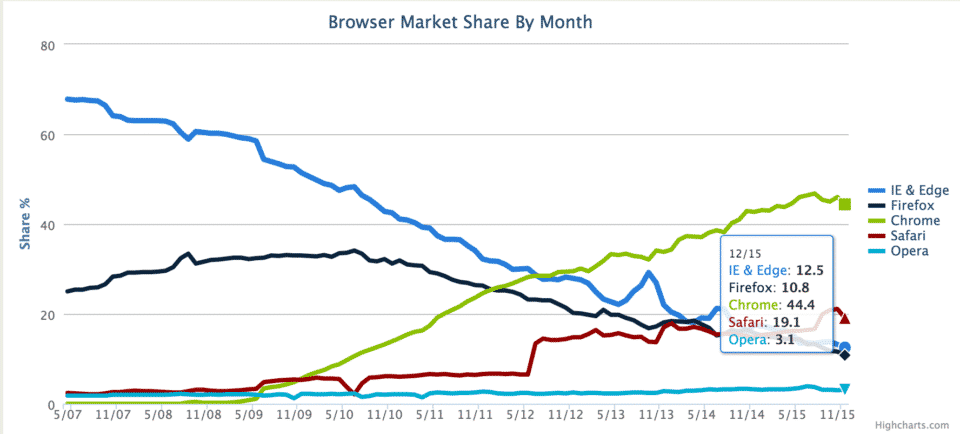
    Web Browser Market Shares May 2007 to December 2015 - Courtesy of w3Counter
    Web Browser Market Shares May 2007 to December 2015 – Courtesy of w3Counter

    Internet Explorer has long been a punching bag of the web. Articles with colorful titles like "Death to Internet Explorer" are celebrating the end-of-life support for IE versions older than 11. This officially went into effect on Wednesday, 12 January 2016, but the effects aren't likely to be seen at many businesses until more pressing reasons to update occur. These are the biggest losers, as it's clear that most users who have the option made the switch off of IE years ago. W3Counter, who among other things tracks global share of browser usage, has Chrome at the most popular browser by market share in late July 2012.

    Commentators are seeing it as Microsoft pushing users to it's new Edge browser, while forgetting that end-of-life policies exist for most major software producers. There's only so long that a company can be expected to support outdated versions of their software, and the impetus on end-users exists to upgrade or risk the consequences. Note that Microsoft still promises security fixes for these older releases, provided that they are the latest that version of Windows can run.

    While this might not be as big a problem in the open source world where active users can continue to enhance their software, close sourced software like the most popular web browsers does not have this freedom. While there are many philosophies to open source software, one thing is clear: if you rely on something produced by another vendor (like the many web apps geared toward IE6 that had to sink or swim when its time came), you'd better be sure you've got contingency plans in place.

    Finally, if you're looking at which browser to switch to, a ZDNet contributor ran some benchmark tests on a mid-tier PC running Windows 7 to determine which browsers offer the highest performance. Chrome tops his list, followed by Opera, with Firefox lagging behind. IE11 is still worse off though, as it is really made for the Windows 10 architecture.


    The Father of Online Anonymity Has a Plan to End the Crypto War

    Andy Greenberg, Wired

    david Chaum, an early developer of online anonymity tools, has been working on a new project called Privategrity with a team comprised of security experts at several universities, with the goal of ending the "Crypto War" between digital rights groups and world governments.

    The tool is intended to put a controversial backdoor system in place that many government groups, including the CIA and FBI in the US and GCHQ in Britain, have been fighting for since the dawn of personal digital cryptography. The method that he has devised involves a nine member security council, with servers located in nine separate countries under nine separate compliance laws. Any attempt at decryption would have to be unanimous under the scheme, which would allow the group in total agreement to block or track specific users.


    Apple’s Tim Cook Lashes Out at White House Officials for Being Wishy-Washy on Encryption

    Jenna McLaughlin, The Intercept

    Tim Cook, along with representatives from Facebook, Twitter, Cloudflare, Google, Drop Box, Microsoft, and LinkedIn, met with White House officials this week to discuss encryption and product security as well as the use of their technology by radical groups.

    Cook and the other Silicon Valley executives have been adamant in refusal to purposefully weaken their software security. A briefing of the meeting has indicated that in addition to encryption, detection and measurement of radicalization on the companies' platforms was another top priority of the meeting.


    The heroes who saved the Internet in 2015

    The Daily Dot

    To ring in the new year The Daily Dot published their list of influential folks in the realm of internet freedom in 2015. Ranging from the realms of government, like Gigi Sohn of the FCC and Senator Rand Paul, to Academics like Alison Macrina of the Library Freedom Project, through private sector employees like Colin Crowell of Twitter, the list covers a wide range of people fighting very hard for the rights of others using the internet. Reading through the list is also a great way to get caught up on some important issues regarding internet freedoms, and find new resources like the Electronic Frontier Foundation's "Who Has Your Back" report, detailing companies that defend their users' data from the government.


    "Je Suis Charlie," but your free speech is terrorism

    Cory Doctorow, BoingBoing

    Just a reminder that words and actions are not the same thing. Where strong verbal support has come out for the defense of free speech in France after a localized attack on satirical news magazine Charlie Hebdo just over a year ago, that support was not in evidence while free speech rights in the country have been systematically curtailed, ramping up following the November Paris attacks.

  • This Week In Web #1

    This Week In Web #1

    Is Twitter going to remove the 140 character limit?

    Telegrapher by Don O'Brien
    “Telegrapher” by Don O’Brien

    Leigh Alexander and Jeff Jarvis over at Slate talked about why it would be a good thing to up the limit to 10,000 characters, in an appropriately long 10,000 character article.

    What’s this all about? Twitter CEO, Jack Dorsey, posted a cryptic screenshot – via tweet, naturally – that is being seen as a sign that they’re planning on lifting the 140 character limit to tweets. Where does 10,000 characters come from? That’s the limit for direct messages, and has been suggested by internal sources to be the same limit being considered for standard tweets.

    I would personally miss the brevity of form enforced by the current limit. Sure, it was sometimes hard to work with (maybe exclude @ replies or links from that limit?), but the medium created a new type of message. It fully embraced the perceived lack of attention span of its audience, and made me feel like a digital telegrapher.


    Building a Startup in 45 Minutes per day While Deployed to Iraq
    Matt Mazur, mattmazur.com

    Matt Mazur is a great guy who currently works with Automattic on their data team. He has quite a history with the tech industry, with two startups under his belt while serving in the Air Force. While on deployment to Iraq in 2011 he added a third, Lean Domain Search. I’d been using Lean Domain Search before having met Matt, or even before knowing that he lived in Orlando and ran in similar circles to me.

    Automattic acquired the company in 2013, making him one of four of their employees in the area. Speaking of Automattic, Business Insider just posted an article on the hiring practices of the company, like how employees can make their own hours, work wherever they want, and rarely even speak to or see Matt Mullenweg before getting hired.

    Matt believes that he would have completed the project sooner had he not been deployed, but at the same time he was more focused in the precious time that he had to work on it. From Matt: “It’s good to have constraints that force you not to bullshit around. [The deployment] gave me space to focus on what was important.”

    Matt’s story is a good place to look if you think that you don’t have time to work on something that you care about. It’s also a good example of how doing good work and caring about it can lead to great outcomes. Congrats Matt!


    Saucy ‘Escort Cards’ Were a Way to Flirt in the Victorian Era
    Becky Little, National Geographic

    Escort Card
    Image by Alan Mays

    These days we have Tinder, but in the late 1800’s there was no such way to indicate interest in somebody. Or was there? This is new to me, but apparently some upper class Americans during the Victorian era would discreetly display interest in public by passing along escort cards to one another. We’re talking “May I escort you home?” here, not “Here’s ten pound sterling, be my escort.”

    Just like current online dating, the field seemed to be played much more by men than women. There were a variety of cards, some innocuous, and some were decidedly not so.


    Here’s what you can no longer say on Twitter
    Jessica Contrera, Washington Post

    Following back up with Twitter, apparently people need a reminder that they are a privately owned company, and not a public service. This is mostly apparent when discussions of acceptable usage of the service arise, and last week Twitter updated their policies on community abuse. Among the things that are prohibited on Twitter:

    You may not promote violence against or directly attack or threaten other people on the basis of race, ethnicity, national origin, sexual orientation, gender, gender identity, religious affiliation, age, disability, or disease.

    The update announcement does make it clear that they are attempting to strike a balance between free speech and user rights, and many of the actions that would be taken to an account that is not in compliance stop well short of straight up account deletion. Still, it’s always good to have a reminder that what you consider your data isn’t only owned and controlled by you.


    Facebook made its Android app crash to test your loyalty
    Kwame Opam, The Verge

    What if Google removed Facebook owned apps from the Play Store? Would users still use the social networks as heavily on their Android devices? The Verge suggests yes, based on the outcome of a report that indicates that Facebook purposefully introduced crashing bugs into their app for some users, in order to test their persistence.

    The report by The Information shows that users would rather visit the website on their mobile browsers after an app crash than stop using the site altogether. This ties into a larger contingency plan that Facebook is creating, realizing that being beholden to any phone OS’ leaves them at a disadvantage that they don’t want to have.

  • That Time That I Lived On The Internet

    That Time That I Lived On The Internet

    One of the things that I want to do is get better at producing content, and I’ve started a few projects to do just that in 2016. The first is a weekly newsletter for interesting stories about internet culture that I curate, the impetus of which I share below.


    Reposted from the launch post for This Week in Web

    I live on the internet. What some in the past would have said is to an unhealthy degree, even. Fewer people say that these days though, and not just because I make my living with the internet, necessitating a fair amount of engagement there.

    Clifford Stoll has already been picked on quite a bit, as the two decades since he shot down the idea of human contact becoming meaningful on the internet (and indeed the idea of meaningful anything on the internet), has been proven quite decidedly wrong. Even Clifford himself has acknowledged this, but you cannot blame him for that view at that time. Surely we cannot expect that the large machines that we are forced to interact with in the office, jealously guarded by the esoteric knowledge of the smug class known as “The IT Department”, connecting to other large machines via the arcane mysticism of many a bearded sysadmin would fundamentally revolutionize the way that we live, work, and play.

    But the revolution has indeed come, and we’re all currently feeling the effects of it. The struggle with what the internet does to us, as both individuals and as society, is ongoing and unrelenting. It seems unthinkable to suggest that the average person in a developed nation could depart from the internet, to the point that the UN has suggested that unimpeded access to the internet should be a universal right.

    This newsletter is an extension of my interests concerning the internet, and how it has changed how we think about the world and each other. Expect stories about internet subcultures, digitally mediated interaction, and the political and legal battles surrounding all of this. I dig around constantly for interesting stories concerning the internet, and will surface the most interesting finds every week via the newsletter.

    Do you have anything that you think I’d find interesting? Share it so I can include it!

🌙 ☀️