
Category: Newsletter

  • This Week in Web #20

    This Week in Web #20

    We’ve left the teens! This Week in Web is still a passion project, but it would mean the world to me if you share with one friend who you think might like this type of coverage.

    Graffito of Bradley or Chelsea Manning, Vienna, Austria by Flickr user smuconlaw
    Graffito of Bradley or Chelsea Manning, Vienna, Austria by Flickr user smuconlaw

    The Appalling State of Appeals for Chelsea Manning

    Chelsea Manning has been imprisoned for three years already of a 35 year sentence for the leak of over a half million military documents, considered the largest in history. In the years since, her legal team has been working on an appeal for a shorter ten year sentence. Wired has a bit of detail on why exactly the appeal has taken so long.

    Manning’s lawyers believe that the case was built on speculation, and does not represent actual harm. This is an important part of the appeal, as the Espionage Act which she was charged under does not have provisions in place for the public good that has come of the leak to come into account.

    Contrast this with General david Petraeus, who is somehow different than Chelsea in a way that I can’t quite put my finger on… Whatever it is, it allowed him to sleep with his biographer, hide information, share government secrets, lie about it, and end up with a fine, probation, and the ability to maintain a security clearance and advice the White House.


    Chrome deletes Backspace

    Simon Sharwood, The Register

    Chrome developers might suggest that it’s a limited number of users that are affected by lost form data when they click backspace and leave a page, but it happens to me often enough that I am happy to hear that backspace no longer functions as a page back button in Chrome.

    Some users surely have it as part of their workflow, but it was always accidental for me. Of course, it could all be avoided if more form systems incorporated local storage usage and cached field data.


    Google’s New Allo Messaging App Gets Its Edge From AI

    Cade Metz, Wired

    Google IO was this week, and they’ve revealed some cool things. I’ve been waiting for a way to use Google Now around the house, and I’m ready for Allo and Google Home to enter my life. It’d be cool if OnHub had the features of Google Home to replace my Amazon Echo, but I’m prepared for the headaches of new devices and their quirks.


    The Urban Legend of the Government’s Mind-Controlling Arcade Game

    Natalie Zarrelli, Atlas Obscura

    I’d never heard the story of Polybius before, but Atlas Obscura gives a good overview of an urban legend around a mysterious coin-op machine tied to a shady government organization. Now that I’m aware of it, I’ve started looking at the network of stories that have cropped up around this arcade game and the various references made in pop culture. Do you have any video game myths or creepy pasta? I’d be very interested in hearing about it!


    Evaluating the privacy properties of telephone metadata

    Jonathan Mayer, Patrick Mutchler, John C. Mitchell, Stanford University

    I caught this on Bruce Schneier’s Blog, which corroborates stories that security researchers and privacy advocates have been saying for years: metadata is plenty useful for tracking people, even without content logs. Basically, using metadata (location, phone, numbers called to and from, etc) from informed and consenting users of a call and text app, Stanford researchers were able to detail social graphs of their test subjects. Additionally, they demonstrated that under the “two-hop rule” that allowed the NSA to track all people that were within two levels of contact with a surveillance target would net around 25,000 new people to track based on a single suspect.
  • This Week in Web #19

    This Week in Web #19

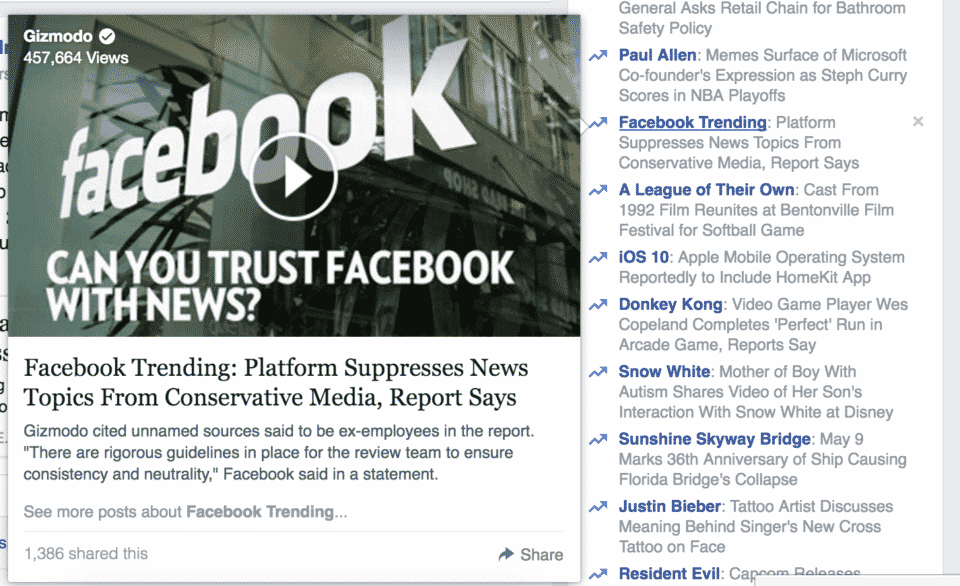
    Facebook Trending Topic about Facebook News

    Were we Expecting Exacting Balance from Facebook?

    As a company run by humans, biases should be assumed.

    Facebook is biased. It’s not purely a question of if tech companies are biased, but could any organization honestly be considered unbiased?

    Big news was made this week of how journalism works at Facebook in a few posts on Gizmodo, including information by a former (but anonymous) employee on the stifling of conservative news. This was followed by reports posted by The Guardian of editorial guidelines around trending topics, which like editorial guidelines at more traditional publications, detailed how and when changes should be made to the trending topics, and how metadata should be incorporated, such as relating stories to users on the site.

    What you feel about this probably depends a fair amount on your political leanings. As the Wired article above notes, Mark Zuckerberg and many prominent Silicon Valley executives are unapologetically liberal. This doesn’t include Palantir founder Peter Thiel, a Libertarian California delegate for Trump, more about him in the story below. Conservative outlets like Breitbart are quick to point out this bias, though Breitbart never puts an indication in their reporting (nor have I seen in other reports) that their content was purposefully removed from the feed. That’s not to say that it isn’t happening or that it is, but that’s partly the point: we just don’t know.

    Facebook is now a news outlet, and people, not algorithms, call the shots. The fact that humans intervene means that there is bias built into the reporting, no matter how pure their intentions. Indeed, algorithms themselves are inherently biased. As Recode notes however, being the largest distributor of news information in the world, Facebook needs to be clear about the process that they use to maintain journalistic integrity. They don’t just distribute data now, they also curate it, such as by paying celebrities and media companies to post Facebook videos.


    Inside Palantir, Silicon Valley’s Most Secretive Company

    William Alden, Buzzfeed

    This was a bit of a present that appeared on Buzzfeed last Friday afternoon. Reporter William Alden has done a detailed analysis on documents relating to the company, as well as interviews with past employees and clients, to determine that not all is rosy in the world of a secretive, enormous big-data analysis company founded by Paypal co-founder Peter Thiel.

    Much of the reporting is on financial discrepancies between bookings, the Palantir term for invoiced work, and actual payments. Alden also notes that over 100 employees have left the company in less than four months so far this year, and at least three huge clients have left: Coca-Cola, American Express, and Nasdaq. Palantir is also famous for low pay for their employees, and records corroborate a story that they increased pay for all employees that had been with the company over eighteen months at least 20%, and cancelled annual performance reviews.

    By many outward facing indicators, Palintir isn’t maintaining clients the way that they used to, and are struggling to grow as a business despite the heavy investment that they’ve received from their founder and other venture firms.


    Mozilla Wants Heads-Up From FBI on Tor Browser Hack

    Dan Froomkin, The Intercept

    If the government finds a technical flaw that allows them to catch people that most of us would consider bad guys, should they be forced to disclose it to the affected company for product fixes? Mozilla (and many others, myself included) thinks so.

    The FBI revealed that a security flaw in the TOR browser, based on Firefox, allowed them to take over a child pornography site and distribute malware to visitors, making them easier to locate, incriminate, and arrest. Lawyers for one of the accused won the right to review the malware, though it’s not clear if the federal government will honor the request.

    Mozilla’s lawyers make it clear that they’re choosing to avoid a fight over whether the bug should be revealed or not, but are instead suggesting that if the code is released, they should get private access to it first, with the intent of patching the bug, before the code goes public.


    Researcher arrested after reporting pwnage hole in elections site

    Darren Pauli, The Register

    Ah good, a voting scandal story from my neck of the woods, Florida. Specifically in Lee County, which contains Cape Coral and Fort Meyers.

    Security researcher, david Levin, exploited, then disclosed, a SQL injection vulnerability to gain access to the Lee County state election website, including the ability to gain supervisor credentials and logins. Part of the issue is that he also posted the exploit online in a video, which he did in conjunction with a candidate for the supervisor of elections position, Dan Sinclair.

    https://www.youtube.com/watch?v=38rsseDeFYQ

  • This Week in Web #18

    This Week in Web #18

    I’m very happy that the majority of this week’s content, whether I had seen it or not, was suggested by readers of the newsletter. I’ve had a lot of fun putting This Week in Web together for the past four months, and will continue to do so as long as readers find value in the content.

    Duck Duck Go Shirt by Flickr user pixishared
    Duck Duck Go Shirt by Flickr user pixishared

    Google competitor DuckDuckGo made so much money last year, it’s giving away $225,000

    Julie Bort, Business Insider

    Duck Duck Go is an alternative search system to Google search, which emphasizes anonymity and privacy in search, at least as far as the company itself controls. They routinely donate to several free and open source software companies to help with development, and this year asked their users in a survey which companies should be supported.

    After tallying votes, nine companies were selected to receive $25,000 each, all with a focus on web security, privacy, anonymity, and related projects. See the full announcement and list of companies in the post on the Duck Duck Go website.

    Thanks to Gary Kovar for sending this over. Submit a link for next week!


    Egypt’s Newspapers in Open Revolt Over Police Attack on Press Freedom

    Robert Mackey, The Intercept

    Looks like the Interior Minister of Egypt finally pissed off the wrong people. For “plotting to overthrow the regime” by attempting to do their jobs properly and report on anti-government protests, two journalists were arrested after a raid.

    In solidarity, newspapers in Egypt, including the state owned paper, started adding the phrase “Journalism is not a Crime” to their papers and websites, printing his photos in negative, and have threatened to refuse printing his name until he is fired. The unity between the newspapers is a powerful statement, and hopefully some reform comes of their standing up to the government, and not more arrests, or disappearances like publisher Lee Po of Hong Kong last year.


    Apple Stole My Music. No, Seriously.

    James Pinkstone, Vellum Atlanta

    I’ve had issues with incorrect matches with Google Music, but at least they haven’t started stealing my music. By stealing I mean the literal sense of it, not duplication, as the files are erased from the host computer after being uploaded to the Apple Music servers.

    Some of the issues here, and there are many, are that you lose access to your music if you aren’t connected to the internet, if you don’t continue your Apple Music subscription, or if they make an incorrect guess and serve up the wrong song, or a crappier version of it.

    Honestly, I’m surprised that Apple would try such a stupid ploy. Plenty of people will try the free trial of the service and decide that they don’t want to pay for it, only to find that their own music was removed. Again, it’s not like a copy was made, but the original files removed.

    Thanks to Stephanie Brinley for sending this over and supporting the site! If you’ve got a link that you want to share, submit it here.


    Ten-year-old receives $10,000 reward for finding Instagram bug

    Nicky Woolf, The Guardian

    A boy from Finland, at ten years old, is the youngest person ever to receive a bounty from Facebook-owned Instagram for discovering a security vulnerability in the service. The vulnerability, which was closed in February, allowed users under certain conditions to delete other users’ comments on photos. I certainly hope that the recognition from such a large company, as well as the $10,000 payout that he received, help keep the boy and others his age interested in hacking away at websites and learning by breaking things.

    Thank you for the topic suggestion, Scott Mann! Got something to share? Submit it here.


    What It Was Like To Build A World Wide Web Site In 1995

    Ben Edwards, FastCompany

    In this longread, Ben Edwards shows that we may think it’s a pain to build a website now, but there are a lot of things that we don’t have to consider that he did when he started, like if your devices have PPP and TCP/IP support or writing winsock scripts. Remind me not to get annoyed next time I need to update a plugin or something.

  • This Week in Web #17

    Kids Playing Minecraft @ Gamescom 2014 courtesy of Marco Verch
    Kids Playing Minecraft @ Gamescom 2014 courtesy of Marco Verch

    The Minecraft Generation

    How a clunky Swedish computer game is teaching millions of children to master the digital world.

    Clive Thompson, The New York Times

    Yes, this article is over a week old and you may have seen it, but it’s too good to pass up. My first introduction to programming began with the release of Lego Mindstorms in 1998, where I clicked together physical Lego brick coupled with motors and sensors, then clicked together blocks of code into chains, similar to the lessons that can be found on Code.org

    Minecraft is one of the most popular games of all time, and with good reason. It is not simply a video game in the conventional sense that we’ve become accustomed to. It isn’t even a game at all by many of the standards of story, structure, outcomes, and goals. There’s no princess to save, no final boss to beat, no planet to defend (minus the survival mode that you can choose to play). Instead there is an open world that you can fill with any creation that you can imagine, and it’s a world that encourages hacking and discovery.

    The discovery process is important here, as well as the freedoms that players enjoy. There is no tutorial when you start planning, no predefined path that you must take. Instead the rules of this world are revealed as you explore, and some new rules are created when you choose to create them. The game has been out for seven years now, and we are quickly approaching a point where children growing up playing Minecraft are entering colleges and vocations and using the skills that they honed from play to create new things in our world. I’m excited by the possibility of a world of creative thinkers, and hope that discovery via play is encouraged even more.


    https://twitter.com/kanyewest/status/699376240709402624

    Suit Aimed at Kanye West Begs Question: Are Tweets Legally Binding?

    Joe Concha, Law Newz

    Let’s say you’re Kanye West and you say that your latest album, ‘The Life of Pablo’ will “never never never be on Apple”. Now let’s say the album comes out and it’s for sale on Apple’s iTunes service. Does your Tweet count as deceptive advertising?

    If you’re Justin Baker-Rhett, you not only believe that, but you’re willing to open a class action lawsuit against West and Tidal, the music streaming service founded by Jay-Z that he is part owner of. It’s been suggested that over two million new subscribers came to Tidal at $9.99/month to get the supposedly exclusive album that you can buy elsewhere and stream on Spotify, the much larger rival to Tidal that many of these subscribers would already have.


    Prince Font Floppy Disk courtesy NYMag
    Prince Font Floppy Disk courtesy NYMag

    The Legend of Prince’s Special Custom-Font Symbol Floppy Disks

    Brian Feldman, New York Magazine

    Honestly, I am far more a Bowie fan than I’ve ever been a Prince fan. The main thing that I was reminded of at news of his passing last week that despite being a pretty heavy web user, taking interviews in chatrooms in the 90’s, he was also a bit abstruse. When Prince famously changed his name in the early 90’s, his design team put together a


    A complete guide to the new ‘Crypto Wars’

    Eric Geller, The Daily Dot

    The timeline put together by Eric Geller only goes back to early 2003 and the aftermath of the Patriot Act and the Domestic Security Enhancement Act of 2003 which though never officially passed helped pave the way for the current crop of encryption debates in the US. While it’s not all encompassing, it’s a good overview of where we are on domestic encryption views and how we got here post 9/11.

    For a more detailed look at the years prior to 2003, Steven Levy’s 2002 book ‘Crypto: How the Code Rebels Beat the Government Saving Privacy in the Digital Age‘.


    New Study Shows Mass Surveillance Breeds Meekness, Fear and Self-Censorship

    Glenn Greenwald, The Intercept

    Privacy activists often refer to a “Chilling Effect” that goes far beyond the actual surveillance and direct silencing of free speech, into the scary realm of modified speech and thought based on the knowledge that surveillance might be taking place. Greenwald points to several studies that show that this is not just a hypothetical, but a reality in which people are less likely to use Google or Wikipedia to research specific topics in fear of looking guilty of made up crimes by their governments.


    UX, According to Larry david

    Joe Pendlebury, UX Chap

    Curb Your Enthusiasm’s Larry david had a lot of strong opinions, both on the show and in real life. Joe Pendlebury collected some hilarious gems from the show and related them to user experience design, and the need to balance development and design with user expectations and needs.

    Hat tip to Jeff De Wit for this one! Submit your own stories for next week


    The British government is considering paying out research grants with bitcoin

    Joon Ian Wong, Quartz

    Blockchain technology is poised to make a large variety of currently opaque or hard to track systems much more transparent over the coming years. One suggestion being research is using Bitcoin or something similar for the British government to disburse research grants, making it much easier to track and independently verify that money is being allocated and distributed as promised.

  • This Week in Web #16

    This Week in Web #16

    Technology and Elections

    Elections are kind of a big thing right now. The United States suffers from unreasonably long election cycles in presidential races, to the point that most major candidates have been on the trail for over a year already, with more than a half year left until election day.

    What if that was all for naught? What if someone could harness the internet to affect the results of an election? Andrés Sepúlveda claims to have done exactly that on multiple occasions for elections across Latin America, and is using his 10 year prison sentence for related hacking charges to detail exactly how he operated, and how candidates and officials can better protect themselves from others like himself.

    This isn’t just idle thinking. While Facebook promises that it has no interest in controlling elections, both internal and independent studies of activity on the social network indicate that in tight elections, it could swing outcomes based on what is or isn’t shown in newsfeeds. More importantly, if Facebook decided to do this, there’s nothing that could legally compel them to cease, or even disclose that they’re doing this. The last point is important, as it could be nearly impossible to externally perceive with certainty whether they use their invisible hand to guide politics.

    If you’ve got more interest, take a look at a TedX talk by Princeton computer science professor Andrew Appel, who has been a longterm advocate of open sourcing electronic voting machines, and demonstrating several ways that they can be tampered with on his Princeton research page.


    Researchers Crack Microsoft and Google’s Shortened URLs to Spy on People

    Andy Greenberg, Wired

    Most of the usage for Bitly and related services is for convenience, with security mainly intended as an afterthought, if considered at all. URL Shorteners are services that allow you to take any URL and shorten it with a custom URL. For instance, last week’s newsletter can be visited if you click through the link http://dino.team/1ML14DD.

    The issue with services like this is that after you know the shortener url (like t.co, fb.me, and wp.me for Twitter, Facebook, and WordPress.com, respectively), you can start guessing at URLs. Researchers at Cornell Tech were basically able to brute force live URLs for several services that linked to private pages, including Google Drive files, map directions, Microsoft Drive, and more. Basically, the amount of security (beyond private pages) on these links was security through obscurity: it was assumed that people who weren’t given the link wouldn’t be able to stumble upon a 6-8 character combination.

    It’s hard to avoid this sometimes, as multiple of these services will create short links for you without giving the option. While several companies have already pledged to improve their security by increasing the character count of the short URLs (which already can defeat their purpose to an extent), some companies have opted to turn off short links entirely. Microsoft OneDrive did this, though the researches point out that URLs saved still point to their respective pages.


    Emoji Pillows by Flickr User Wicker Paradise
    Emoji Pillows by Flickr User Wicker Paradise

    Apple did not invent emoji

    Eevee, Fuzzy Notepad

    Emoji have been growing more heavily in popularity of late, what with every messaging platform having to support them by default now. A programmer and writer with one of the best URLs ever has written a comprehensive overview of the Unicode Consortium


    I am Alex St. John’s Daughter, and He is Wrong About Women in Tech

    Amilia St. John, Medium

    It takes a lot to piss of your daughter enough for her to right a rebuttal to your views online. Amilia St. John, daughter of WildTangent founder, took to Medium to discuss how disgraced she was with the views of her misogynistic father, who is preaching hiring and promoting techniques that make it hard for technical women like her to thrive in the workforce.


    The Strange Tale of Social Autopsy, the Anti-Harassment Start-up That Descended Into Gamergate Trutherism

    Jesse Singal, New York Magazine

    Launch a Kickstarter to start an anti-harassment company to specifically deal with cyberbullying. Become a cyberbully yourself. The implosion of Social Autopsy before it even began is a testament to how skewed the arguments over gamergate and online bullying can be.

  • This Week in Web #15

    This Week in Web #15

    UC Davis Pepper Spray Incident photo by Louise Macabitas
    UC Davis Pepper Spray Incident photo by Louise Macabitas

    UC Davis spent thousands to scrub pepper-spray references from Internet

    Sacramento Bee

    For some reason University of California, Davis wanted to clean up it’s online reputation. Oh wait, they make the reason quite clear: to make the college’s chancellor, Linda Katehi, look better after the scumbag Lt. John Pike pepper sprayed unarmed protestors on campus. Don’t worry about him though: he was awarded $38,000 in worker’s comp for his “psychiatric trauma“.

    UC Davis (a public, government funded university) spent at least $175,000 on contracts with online reputation management companies because of Katehi’s hurt feelings. Maybe she was psychiatrically traumatized as well? I can’t say that I would forget that event happened were I applying there as a student, but perhaps they thought that attendance would suffer due to “venomous rhetoric” about the chancellor.

    It’s not to say that online reputation management is a bad thing. Jon Ronson, author of ‘So You’ve Been Publicly Shamed’ talks about the good that they can do, and how the lack of consequences for internet commentators, myself included, can put unfair burden on the targets of harassment. Ronson himself has been attacked online, and even impersonated extensively. Still, maybe sometimes it’s not just sniping from afar, but reminding people that standards that we would be kept to can be maintained for others, and public money might be better spent than keeping government employee feelings from getting hurt while causing real damage to others.

    Thanks to Matt Cutts, head of webspam for Google, for pointing out this story. So much for that reputation management, UC Davis.


    Facebook Has Seized the Media, and That’s Bad News for Everyone But Facebook

    Julia Greenberg, Wired

    Facebook has done a ton to keep people hooked on their site. The additions of features such as instant articles, 360 degree video, and the hyped AI chatbot, M, are geared around keeping you on Facebook longer, for more things. If you plan on getting news and entertainment, the reasoning goes, you should get it through us.

    The issue at hand is how this de facto ownership of media can sway what is being said and how. Facebook creates a new feature, and newsrooms across the world move budgets around to accommodate. The allure of the views that await is intoxicating, and the danger of missing user screen time is a financial fear driving decisions. There’s a bandwagon created for media outlets to hop on and ride to active engagement time. The question is if there’s a better way to drive new development around stories and newsworthiness, rather than shiny features.


    Why my videogame chooses your character’s race and gender for you

    Garry Newman, The Guardian

    We understand this is a sore subject for a lot of people. We understand that you may now be a gender that you don’t identify with in real-life. We understand this causes you distress and makes you not want to play the game anymore. Technically nothing has changed, since half the population was already living with those feelings. The only difference is that whether you feel like this is now decided by your SteamID instead of your real life gender.

    Online video game Rust, a survival title, has added a new feature to character creation. Where once it was just your race that was programmatically selected based on your Steam ID, your character’s gender is as well. It’s almost painfully obvious that certain people who treat games as the end all of life, with women trying to destroy that bastion of ubermale fantasy freedom, will get offended.

    The lead developer of the game spoke up in advance of the change, well aware of how some people would react. He pointed out that some players, a large portion of them, were being forced to play as the opposite gender in the past, and it seemed to be a less spoken issue until forced game gender was an equal opportunity endeavor. He didn’t point out that female players have very little to choose from in almost every major game title, but why does that matter when almost half of gamers are women, a number that is steadily rising?


    Over 1.8 million certificates, securing 3.8 million sites with Let's Encrypt. Source Let's Encrypt
    Over 1.8 million certificates, securing 3.8 million sites with Let’s Encrypt. Source Let’s Encrypt

    A Scheme to Encrypt the Entire Web Is Actually Working

    Andy Greenberg, Wired

    Let’s Encrypt is moving out of beta! The certificate authority, funded by Mozilla, EFF, Akamai, and other web giants, provides free TLS certificates to end users. Let’s Encrypt has been in public beta for less than six months, but already it’s become the third largest certificate authority in the world, serving up certificates for over 3.8million sites. The goal is to encrypt the entire web, making it more secure and safe for ever user, and this is a great start.

    Is TLS Fast Yet? You bet it is 🙂


    Tesla Mario Kart Rainbow Road Easter Egg

    Contributor Lisa Melegari thinks that this has to be a late April Fool’s joke, and I’d be inclined to agree. Evidently, putting the Model S and Model X Teslas into autopilot four times in a row triggers a Rainbow Road driving animation on the vehicle display. Is that more or less dangerous as a distraction than insane mode?

  • This Week in Web #14

    This Week in Web #14

    The Panama Papers – Exponential Growth in Data Leaks will Continue

    One of the largest news stories to break this week, over a year in the making, are the so-called “Panama Papers”. There’s been a lot of discussion over them, but as they deal with something largely invisible, namely the movement of funds from offshore accounts to shell companies, the true power and extend of the Papers has yet to be seen.

    That’s not to say that we haven’t already seen some intense action around the revelations in the first few days of release. Vladimir Putin might shrug it off in his own country, and david Cameron might not have to resign after admitting his own involvement, but there have already been a few casualties. The prime minister of Iceland, Sigmundur Davíð Gunnlaugsson, was forced to resign earlier this week. His party has already chosen a successor, knowing that if an election was forced today, the Iceland Pirate Party would be likely to claim power. The CEO of Hypo Landesbank Vorarlberg, Michael Grahammer, is also out, and there are bound to be others by the end of the week. The Panamanian Government has created a ‘panel of experts’ to help improve the image of the country home to law firm Mossack Fonseca, whose internal leaked files show billions of dollars in illegal money transfers.

    These kind of leaks are bound to get more common and larger over time, not less. When Daniel Ellsberg leaked the Pentagon Papers in 1971, he had spent many months photocopying over 7,000 documents by hand. Chelsea Manning leaked hundreds of thousands of documents that were smuggled out in CD-R’s and camera memory cards. Edward Snowden and unknown sources behind NSA and Hacking Team leaks were able to physically and digitally move millions of documents in one of the nights of endless copying that Ellsberg had to take when his sources were physical pages. The 11.5 million files that are being examined and tracked in the Panama Papers are a harbinger of the future of leaks, where coordinated research and clandestine transfer of digital files leave it to a matter of when, not if, the dirty secrets of the powerful are revealed to all. How we react to them is what truly defines us.

    On a side note, as a WordPress developer I always tell my clients and everyone around me to keep their sites up to date, including plugins, themes, and WordPress core. Turns out that failure to do so might have helped the hackers who breached the Mossack Fonesca email servers.


    Meet the bughunters: the hackers in India protecting your data

    Vidhi Doshi, The Guardian

    Most large tech companies offer bug bounties, rewards for finding flaws in their code, mainly security flaws. The idea is that offering up incentive for general users to discover and hand over this information will make the systems stronger and more secure overall, as well as stop bad-actors from using it for personal gain.

    The intersection of edge-case testing from non US devices and modest rewards that can be especially substantial in developing countries have made developers like Anand Prakash in India the leaders in bug hunting. These testers are at least partly motivated by altruism, as these same bugs could be sold on the black market, potentially for much more than the original companies offer.


    CNBC’s secure password tutorial sent your password in the clear to 30 advertisers

    Cory Doctorow, BoingBoing

    CNBC had a good idea when they created a password testing tool, but they had a bad idea when they didn’t do anything to stop the passwords entered from being stored and transmitted to third party sites, over thirty different advertisers to start with. The form was also submitted in the clear, meaning that others on the network used when testing could see the passwords being tested, ostensibly passwords that the visitors actually used. They claimed not to store the information, yet Google security engineer Adrienne Porter Feltshowed that all submissions were written to a Google Drive Sheet. Even better, the form was poorly estimating the strengths of the passwords entered.


    The Way I Work: Jason Fried of 37Signals

    Liz Welch, Inc

    Jason Fried, founder of 37Signals, likes the phrase “less is less”. Exhibit A: the company, renamed Basecamp last year to represent their shift of focus to their most popular product, the eponymous project management tool, focuses solely on that service, shuttering or merging other tools that ended up being more of a time grab than core business. Read his interview on simplicity and company culture at Basecamp, which essentially boils down to don’t waste time, and treat people like equals who are deserving of respect, employees and customers alike. Words that I am working to take to heart, one step at a time.


    Your Healthy Lifestyle Won’t Necessarily Make You Healthier

    Sandro Galea, Wired

    We’ve got a plethora of apps and gadgets designed to get you healthy, or at least remind you that you’re unhealthy as they sit unused in your app dock and on the nightstand after the battery died and you never bothered to recharge them. The question for even those of you using fitness tech on a regular basis is: does it even work? We like to think that we’re in control of our own destinies, including our physical and mental health, but studies on a variety of illnesses continually show that action or inaction on your part can potentially alleviate symptoms, but not reverse course on most illnesses.


    Saving a Post

    GIPHY CAPTURE. The GIF Maker

    Not a paid promo or anything, just a cool new tool from the team behind Giphy, the gif database that makes it much easier to find the perfect expression of “That thing when” for your Slack channel. Currently for Mac, you can use the tool to make a gif of any portion of your desktop, making it easy to create your own gifs from videos, or make short tutorials on how to accomplish some task. Bask in my posting of the newsletter!


  • This Week in Web #13

    This Week in Web #13

    Hundreds lined up at the Tesla dealership in Orlando, FL to pre-order. Photo courtesy Professor Josh
    Hundreds lined up at the Tesla dealership in Orlando, FL to pre-order. Photo courtesy Professor Josh

    Will America Ever Care About Electric Cars?

    If they’re as sleek and affordable as the Tesla Model 3, it looks like the answer is yes.

    Yesterday was the long awaited day that Tesla Motor’s Model 3 became available for preorder. Customers had to come in-person to a Tesla dealership to place their preorder, and it appears that was not a deterrent, with lines at many dealerships reaching into the hundreds, just to be higher up the list. Before any consumer has driven one, the car has received over 133,000 orders on day one, despite the fact that the first cars won’t be delivered until late 2017 at earliest.

    From a company that delivered less than 51,000 cars last year, it’s clear that Tesla will have to ramp up their American production to satisfy the demand. It’s also shown that if you give the consumer something that they want – in this case a car that can travel up to 215 miles on a single charge, fit five adults, have two trunks since there’s no need for a messy engine and support systems in the front hood, and make you look super cool – they will change habits. It’s not that (most) people love going to the gas station, it’s that there hasn’t been a viable alternative that wasn’t exorbitantly priced. But for $35,000 (slightly over the median new car cost of $33,560), Tesla is offering an attractive way into the future of lessened dependence on oil and emissions. Maybe that factors in when some people buy, or maybe they just like the idea of lower maintenance and fueling costs, as well as a reasonably priced status symbol, like the early iPod or iPhone compared to other music players and smartphones.

    You might think that this economic shift would piss current winners off, and you’d be right. Green Car Reports has a handy infographic for which states you can buy direct from Tesla in, and for fun, they’ve included a map of average margins of presidential victories over the past two decades, which just so happens to match up fairly well. The argument in some states is that it should be illegal for auto manufacturers to sell directly to consumers, and instead should be forced to go through third-party dealerships. Somehow this duality exists within the same margins that vote down spending deemed wasteful and government positions seen as useless bureaucracy. But hey, it’s different when it’s a company that wants to sell it’s product to it’s clients and not deal with someone who wants a cut for literally no reason.


    Apps can filter out your dates by political party—but that doesn’t mean you should let them

    Jake Flanagin, Quartz

    Would you choose who you date based on their political leanings? It appears in general no, unless you happen to support Donald Trump and are open to sharing that up front. In which case, expect a lot of swipes left.

    Dating app Bumble has added the ability to list who you are voting for, and to be able to filter other users based on this information. While it may matter to some users, adoption isn’t high, and interviews with some users indicate that they want to be open to people with different viewpoints than their own, especially if they are more moderately leaning.


    Netflix’s Grand, Daring, Maybe Crazy Plan to Conquer the World

    Brian Barrett, Wired

    What happens when one company controls content creation as well as distribution? Old movie studios used to know this, and Netflix is the leader of the breed of new tech companies that are learning how to handle production and delivery in a long chain from idea inception to viewers eyes. Thanks to the enormous amounts of data that can be collected and quantified, such as which of the character shots from season two of DareDevil get users to click and view the show most reliably, they can finely tune a machine that delivers what you want as entertainment, when you want it. Without the pesky distribution rights contracts, shows like Daredevil, Orange is the New Black, Bojack Horseman, and House of Cards can be made and then used however Netflix wants. While there is still plenty of space for old fashioned production companies, their all-encompassing power has slowly been eroding, allowing Netflix, Hulu, Amazon Prime and similar video distributors to claim more and more bandwidth and view time.


    One in five employees would sell their work passwords, some for less than $100

    Joon Ian Wong, Quartz

    Most cases of hacking don’t come through brute force attacks or sophisticated technical schemes, but simple social engineering. A survey by software management firm SailPoint asked employees at companies with over 1,000 headcount (also known as more valuable targets) if they would sell their passwords. Globally, around 20% of those surveyed said that they would, for an average value of $82,000. Additionally, two thirds of respondents confirmed that they reuse the same password for multiple company accounts, and one third already shared passwords with coworkers.

  • This Week in Web #12

    This Week in Web #12

    ©Alan O'Rourke via Flickr
    ©Alan O’Rourke via Flickr

    Happy Birthday Twitter!

    Ten years in, and Twitter is at a crossroads.

    Twitter has been called many things over the past ten years. Fad was an early name, before Flight 1549 and the Arab Spring anointed it the most direct, truthful news service.

    A worrying liability and cautionary tale for the failing unicorns around it are labels that can apply today. The IPO of Twitter was hotly anticipated, and the company opened to sky-high valuations, which have come back down to reality over the past two years. As Mathew Ingram points out in Fortune this week, Twitter can be seen as both a massive success and a huge disappointment at the same time.

    The New York Times has gathered the thoughts of several influential Twitter users, most of whom agree that it has been net good, and should continue to be an open, public service. The fact that Twitter the company has to contradict Twitter the service sometimes is a reality of a world where Wall Street expects ever growing returns, and countries expect the ability to control what their citizens can see, hear, or say.

    I personally say a fair amount on Twitter, and hope to see it through another ten years or beyond. At a point I’d like to see it be a public utility, going along with the internet in general as a system that bridges our world and can be used for good. If you want to stick with the positive, skip the Microsoft AI story below, where Twitter users can remind us that not everyone on the service is perfect.


    The Hogan Verdict

    Nick Denton, Gawker

    Terry Bollea’s lawyers are slick, underhanded and play right into the stereotypes that have come to be associated with the profession. The Hulk Hogan sex tape scandal – of which no real scandal could rightly be called to exist with that public personality – was never about a clip from a sex tape, purports Gawker founder Nick Denton. Instead, it was a calculated attempt to shut down or shut up a news outlet that had access to even worse tapes of the showman making racist remarks.

    I’m not a fan of Gawker, Valleywag, or many of the other sites under their media umbrella. I don’t agree with much of what Nick Denton says, but I still believe that he has been a valuable voice for online news. His insistence on remaining independent, not taking any outside investment until forced to by this lawsuit earlier this year, and the fiercely independent streak of reporting are things that I admire. While it may have many enemies in New York, Silicon Valley, the greater media landscape, literally everywhere, Gawker Media can be a canary in the coal mine for what can happen to other online news sites who dare post stories that famous people don’t like.

    Hogan’s defense team originally called for $100 million in damages. The jury awarded them $140 million. The chilling effect that can result from this verdict, which I hope reaches more level heads in appeal, is that organizations who cannot afford to take that kind of hit (I would imagine every news organization out there) will avoid publishing some stories entirely. That is unacceptable, and does in practice what those lawyers can’t do legally: silence voices that displease them.


    Angola’s Wikipedia Pirates Are Exposing the Problems With Digital Colonialism

    Jason Koebler, Motherboard

    Necessity is the mother of invention, and zero-rated internet services lead to free pirate parties. The non-profit in use is understandably unhappy with this secondary use of their service.

    Crafty Angolan users of Wikipedia Zero and Facebook Free Basics, services that have met hostility in some countries, and even an outright ban in India, have setup systems where they use Wikimedia Commons to store music, movies, television shows, and anime, much of it copyrighted. They then link those files in private Facebook Groups, making it a bit easier to discover and share files.

    The hard part for moderators of Wikipedia and it’s related websites is that, while they do not want to be used as a repository for copyrighted content, a blanket ban on Angola or even Wikipedia Zero users in the country is “Not on the table”. While some of what is being done may not be deemed illegal in Angola itself, the services that are enabling don’t want to be too hard on their users or be viewed as totalitarian, but also want to respect the rights being abridged of those copyright holders.


    After racist tweets, Microsoft muzzles teen chat bot Tay

    Hope King, CNN Money

    Earlier this week, Microsoft launched a chatbot on Twitter that was meant to sound like a regular teenager. What ended up happening – surprising no one who has been on the internet ever – was a chatbot that held racist, sexist, xenophobic and bigoted views. Microsoft too the bot offline after a day to work on it, and deleted most of the offensive Tweets, though DMs weren’t able to be removed that way.

    Of course, it’s not the bot, but the users we should fear. Microsoft trained it’s bot to use public Twitter info including tweets directed toward it to learn how to talk, and it did exactly that. After we make working AI, maybe we can make working people.

  • This Week in Web #11

    This Week in Web #11

    iCloud scammer pleads guilty to stealing celebrity nudes

    Joey davidson, Techno Buffalo

    Remember two years ago when someone allegedly hacked into the iCloud accounts of dozens of celebrities, mainly women, and stole nude or otherwise compromising photos of them? The event, dubbed “The Fappening” by certain parts of the internet, turns out to have been almost two years in the making, with perpetrator Ryan Collins using social engineering techniques since late 2012 to gain access to accounts to pilfer for his collection.

    While Collins pleaded to one count of unauthorized access via the sometimes useful Computer Fraud and Abuse Act, he has not admitted to most of the cases, or to disseminating the photos that he did have copies of. It just happens to be a coincidence that the photos in his possession were leaked shortly after he obtained them.


    Low Battery via Flickr CC by Martin Abbeglen
    Low Battery via Flickr CC by Martin Abbeglen

    Closing Apps to Save Your Battery Only Makes Things Worse

    david Pierce, Wired

    Under one of those things that I didn’t think of but makes sense when explained, david Pierce describes the general five states that an app can take on (launched, active, inactive, background, and suspended) and how that affects battery performance. Turns out that the developers of our pocket supercomputers put a lot of thought and effort into developing smart algorithms that manage battery life, and our attempts to meddle are potentially making it worse.

    Long story short: constantly closing apps (of which you’re likely to open again anyway, as most users keep to about five active apps) uses up more energy than letting your intelligent phone figure out how to allocate memory to them. Restarting those ups takes up even more energy, and thus the cycle continues. Plus, are you sure that your phone isn’t using a process from that app when you cancel it?


    Apple’s Brief Hits the FBI With a Withering Fact Check

    Kim Zetter, Wired

    The greatest dangers to liberty lurk in insidious encroachment by men of zeal, well-meaning but without understandingJustice Louis Brandeis

    Apple’s latest brief in the iPhone case involving the FBI and the San Bernadino shooter explains it to the feds as though they are children who don’t understand technology, which by now they must truly believe. A walkthrough of Apple software is part of the argument, contrasting assertions of selective syncing and encryption of non-synced data with the technical realities of the software, much of which can be checked by anyone with iCloud and an iPhone. Apple’s lawyers also dig into many of the cases that the government is using in defense of prosecution of the 1789 All Writs Act, stating that they have nothing to do with that act, their case, or the technology behind it.

    As Edward Snowden himself tweeted:


    Why Are We Fighting the Crypto Wars Again?

    Steven Levy, Backchannel

    Author Steven Levy, who wrote a seminal book on Cryptography and it’s purpsose, Crypto: How the Code Rebels Beat the Government Saving Privacy in the Digital Age, is back at it. He questions why it’s taken so long to recognize Whitfield Diffie and Martin E. Hellman, as the A.M. Turing Awards finally have, granting them the award 40 years after they first published their public key cryptography system that changed the world of computing for the better, leading to an internet where more trust could be placed between two parties unknown to one another, such as a product vendor and consumer. This paved the way for ecommerce and almost all interactions that take place on the internet to this day.

    Levy has to bring his argument back, as the issue has never truly gone away: along with demands for privacy and security for ourselves, we demand the ability to break the privacy and security of bad actors, however we define them. The Clipper Chip and Skipjack Algorithm were defeated not only for this hypocrisy, but mainly for the demonstration that a tool that purports to have an entrance that only “the good guys” can access cannot be guaranteed to keep other third parties out.

    Bonus: If you want to get an understanding of how public key cryptography works, check out this video by Brit Cruise via Khan Academy.


    Facebook is eating the world

    Emily Bell, Columbia Journalism Review

    Marc Andreessen is famous, among many other accomplishments, for the phrase “Software is eating the world.” Emily Bell it pointing out the fact that not all software is equal, and highly leveraged software companies have even more ravenous appetites than others. When services like Facebook and Google offer up their own content distribution networks like Instant Articles and AMP respectively, the question isn’t just what we gain by using those services, but what we lose, whether we use them or not.

    One of the things that we lose is control over production, display, and delivery of media. We’re increasingly living in filter bubbles that dictate what new ideas we see. We might not always want to see views that differ from our own, but it’s valuable for forming new opinions. When large companies can decide what things get displayed to who, the value of the open and free internet diminishes, where we trade convenience for the complexity that disparate voices would otherwise offer.


    Don’t Post About Me on Social Media, Children Say

    KJ Dell’Antonia, The New York Times

    The first kids born during the social media age are coming of age themselves now, and many have problems with how freely their parents share about them. This is the first generation who will collectively grapple with how much sharing is good or not when digital media grants us a near endless perfect recall, which may not always be a good thing. Maybe they’ve got a point, knowing how much the detritus of digital personae affect our lives these days. According to the study linked in the article, three times as many children as parents were concerned with limits on what is posted publicly. And you say that your kids overshare online too much.

  • This Week in Web #10

    This Week in Web #10

    Georgie Wood, for Wired
    Georgie Wood, for Wired

    Google’s AI Wins Pivotal Second Game in Match With Go Grandmaster

    Cade Metz, Wired

    Widely seen as a test of the growth of deep learning and neural networks in artificial intelligence, even more than Watson’s defeat of Ken Jennings on Jeopardy! five years ago, Google’s AlphaGo has defeated Lee Sedol in the second of their five scheduled matches. At this point it looks that the tournament may only go to the third game, which Sedol would need to win, along with the last two games, to defeat the computer.

    The rise of the machines may start with defeat at complex board games, but is moving toward purpose-driven artificial intelligences that will manage our lives. I’m confident that we will see a wide range of applications rise from this new thinking machine, allowing advancements in technology and science that will improve a wide spectrum of deficiencies in our lives. When they finally take complete control and subjugate us to endless Go death matches though, we may regret this moment.


    Wired Keeps Calling Trump ‘Someone With Tiny Hands’ Due to a Chrome Extension Error

    Matt Novak, Gizmodo

    Chalk it up to a contributor’s testing of browser tools for another article, or a joke gone awry. It’s believed that a Chrome extension is the cause of misprinted articles in the online publication that had “someone with tiny hands” in place of mentions of Donald Trump.

    The real thought here is how the reality of what we do online can be distorted to the point that we don’t even notice it, and where those that should be keeping better watch (like the editors at Wired who ostensibly didn’t proof these articles) don’t notice either. The danger is in being unable to tell when we’re getting a filtered truth, whether purposeful or through neglect, with no fallback or safeguards to confirm when it’s even happening.

    Props to Lisa Melegari for this find. Suggest a story here!


    Machine-Learning Algorithm Aims to Identify Terrorists Using the V Signs They Make

    Technology Review

    It’s becoming even easier to identify people by different elements that might have been nondescript in the past. It was disconcerting when a Google Glass developer demonstrated an app that could identify people by the clothing that they are photographed in based on images loaded to their public Facebook profiles. Now a team at the University of Jordan has claimed a method to fingerprint people based on the shapes of their hands while making the V victory symbol that has a macabre significance to terrorists posing with victims. Granted, you can’t identify a person with them (the masks hinder that), but tracking individuals across photos, places, and time, is a bit easier using information that they widely distribute.


    FCC to propose monthly broadband subsidy for the poor

    Amar Toor, The Verge

    The Federal Communications Commission is proposing a subsidy for low-income families for broadband internet connections, to the tune of $9.25/month. While I can’t say that pays the bills anywhere that I’m aware of, or even comes close, it could potentially get more people online. The nice thing here is that they are tacitly agreeing to the conceit that an internet connection is now a valuable and necessary part of living in modern society.


    I’ve Had a Cyberstalker Since I Was 12

    Roni Jacobson, Medium

    Some of the things that the author discusses in this article are cringeworthy, and as she says in her subtitle, the odd part is that she didn’t see this as more serious. Read to see a firsthand account of wading through the complexities of stalking laws, especially when it comes to cyberstalking, which is on the rise but still lags behind a bit. The hope is that investigative journalism like this will help shine a spotlight on the issue, and help bring smarter, more up to date laws in place.

  • This Week in Web #9

    This Week in Web #9

    david Scovetta via Twitter
    david Scovetta via Twitter

    Amazon just removed encryption from the software powering Kindles, phones, and tablets

    Patrick Howell O’Neill, The Daily Dot

    All major tech coverage the past few weeks has been on Apple’s fight with the Feds over encryption on devices. Google has backed Apple. Facebook has backed Apple. Even Microsoft has finally backed Apple. Apparently Amazon wnats to think different, removing personal encryption from Fire OS 5. Apparently customers weren’t using it, so they decided to just drop it from the newest version, rather than keep in a useful feature and enabling it by default or putting a tutorial on the device for how easy it is to actually use.


    Daily Accounts of a Muggle I.T. Guy working at Hogwarts

    Unknown

    I wish I had the creativity of some people. There’s a (currently anonymous) Tumblr account entitled “The Setup Wizard” in which a Muggle IT Professional hired by Hogwarts keeps a daily log of what he’s working on. This is a great melding of a popular fiction series and the drudgery of IT. Or maybe it’s real. It’s that engrossing.


    Spotify is using 50,000 anonymous hipsters to find your next favorite song

    Adam Pasick, Quartz

    It’s just like Jaron Lanier predicted! Spotify is touting a new “algorithmic way to discover new music”, which is cool tech, but still boils down to unpaid contributions by users. The Fresh Finds Playlists that are being given prime real estate on Spotify are built around crawling music blogs for new artists, looking at top users who are playing those artists, then finding what other new things those users are playing, becoming a new siren on taste.

    In his most recent book, ‘Who Owns the Future’, Jaron Lanier discusses the fact that these super smart algorithms are really based around data gathered by real people. People who are not getting payment or recognition for the work that they are doing for these large companies. If Spotify is really thinking of entering the record label business, this data would prove insanely useful. After all, Netflix found success in building shows around the viewing habits of their users, and there’s no reason to think that Spotify wouldn’t do the same. Eventually a recognition system for the humans that are the real power of big data and deep learning will have to be put in place, or the value of that data will continue to climb to a point that users with the help of third-party analytics firms will demand payment for their finite resources.


    Sad Togepi

    Niantic Has Cancelled Their GDC Presentation on Pokémon GO to Focus on the Beta Test and Launch

    Jeffrey McDonell, Gamenesia

    I bought the Pokemon New 3DS this weekend, fired up Pokemon Blue after several years away from the franchise, and was reminded of the blend of simple gameplay and complex structure and rule systems that made it popular. Like many, I thought that the trailer for Pokemon Go was a bit over the top, but I’m still excited by the first mobile phone Pokemon game that I’m willing to overlook that.

    It looks like we’ll have to wait a bit longer for more information, as the development team behind the new game have pulled out of the Game Developers Conference set to take place in a few weeks. The reasoning given is to focus the time non-stop on development of the game, which was set to be out in a beta that has also been delayed. Niantic and Nintendo, my phone is ready when you are.


    Do you wish your code could be more pictographic? Emojicode to the rescue!

    Props to Lisa Melegari for this find. Suggest a story here!


    I spent the last 6 months planning my online death

    Caroline Sinders, Fusion

    Most people don’t yet consider what happens to their digital selves after they die. Now that a sizable percentage of the world population is on Facebook, a platform that has been around for ten years and will necessarily start hosting more and more dead users over time, this consideration is going to have to be made more frequently.

    Caroline Sinders researched the ways that many companies do – but mainly don’t – have systems in place for data ownership after the passing of a user. She looked into the many ways that exist informally to handle this gap in coverage, and finally decided to create a digital will, which she created to allow her sister to access all accounts and what she wanted done with them if she died. Digital or not, this is not a bad idea of a document that everyone should create if just to make handling of basic tasks around death (the electric bill was in their name and I never got the notice that it was overdue!) easier to handle, making the passing less of a burden.

    Fusion did a whole series on the future of death this week that’s worth checking out.


🌙 ☀️