Category: Thoughts

  • Halt and Catch Fire is More Clever than Conventional

    Halt and Catch Fire is More Clever than Conventional

    Minor Spoiler alerts ahead, though I don’t go into great detail about the show. The full series is available on Netflix and probably other streaming sites

    We recently watched the series Halt and Catch Fire, which is about a small part of the history of personal computing and the birth of the world wide web. Throughout the show we follow our protagonists as they build a portable IBM clone in 1983, start an online gaming company and BBS before the Internet, and find themselves at the forefront of a variety of computing revolutions.

    The sad aspect of this show is that they are basing it on real world events, and in the real world we know who some of the winners and losers are. That’s why our heroes are the perennial underdog, as each time they stumble upon a major innovation (Online communities! The World Wide Web! Hyperlinking! Search engines!), they are surpassed by a well known rival and left to be the footnote, if they make it into the history books at all.

    An interesting outcome is the subversion of narrative that this basic fact of the show produces. When you invest time in characters you begin to root for their causes. You want these poeple to win, and for their companies to become the ultimate victors in the race for computing supremacy. The fact that they routinely fail is something that you instinctively know will happen barring a rewrite of history, but it is disheartening nonetheless. The world of Halt and Catch Fire is messy, like all of the characters, and it is that messiness that makes it compelling.

    I liked the nods to internet history, the cameos, and the wink-nudges or easter eggs that are tossed in without trying too hard to be clever. I liked the story of a group of underdogs making their way in the world, leaving marks and impressions of various sizes. I didn’t always like how the characters acted, but I understood that they were more fleshed out than caricatures made to force us to feel one way or another.

    One of the highlights of my enjoyment of Halt and Catch Fire was the fact that I could completely agree with the logic and decisions of a character during their many interpersonal feuds, while acknowleding that they were not in the right. Just like the real world you can be the smartest one in the room but with no one willing to listen it will amount to a bitter I-told-you-so.

    I try not to get into too many shows, as the time investment in them can be great. I can say that if you are interested in this specific period of computing history, or enjoy interpersonal dramas that are not over the top, Halt and Catch Fire is worth a look. The show has its flaws, but it ultimately redeems itself even in futility.

  • Running an Alternative to Twitter

    Running an Alternative to Twitter

    I’m interested in the work of the team that is championing the ActivityPub protocol, which earned a W3C Recommendation in January of this year. I’m not part of that team or SocialCG or any team that makes decisions on those specifications, though I would like to be in the future.

    What I do have is an interest in alternative social media networks. More specifically I have an interest in getting more people to share more of their content outside of the walled gardens of the largest social networks like Facebook that keep all user content segregated from the wider web.

    I no longer have a Facebook account of my own, something that I’ll probably write about this week. That already means that some events, website logins, and communities have been closed to me. I’m willing to make that tradeoff in commitment to a more open and connected web, decentralized away from a few large companies maintaining all of the things that we see online.

    Last year I stumbled upon a Twitter alternative that was gaining ground, Mastodon. If you have used Tweetdeck, the interface is fairly similar, and navigating around shouldn’t be that tricky. What is tricky is the concept of federation.

    Federation

    You are most likely familiary with one type of federation on the web: single sign-on. This is a form of federated identity, where you can use an authentication API of one web service to create and maintain an account on another service. The most popular of these in the US are of course Facebook, along with Twitter, Google, and a few other services that vary among industries or use cases.

    In the case of a service like Mastodon, not only are identities federated, but the platform itself is. What this means, coupled with being decentralized, is that individuals can host their own servers with their own instance, or copy, of the software running. Unlike a P2P network where users are communicating directly between one another’s computers, a federated service still uses a centralized server.

    Since individuals can host their own instances of Mastodon, they can set their own rules, and give them their own names, guidelines, and styles. The instance that I run is intended to be a gathering place for LGBTQIA+ folks with an interest in technology. You can find it at tech.lgbt

    If you join my instance, you can still connect with, friend, follow, chat with, “retweet” (or in Mastodon terminology, “boost”) others, as well as share your own statuses of up to 500 characters in what they call “toots”. Your username will follow a naming convention based on the domain of the instance that you joined. My username is david@tech.lgbt.

    I don’t join a lot of other instances directly, as each involves creating a new account. What I can do however is interact with people on those instances, both by visiting them directly and seeing them in my personal feed. If I want to follow the statuses of and respond to the creator of Mastodon, I can go from my account on tech.lgbt and follow Gargron@mastodon.social directly. This means that I don’t need to create an account on mastodon.social to see what he’s up to.

    Why does this matter?

    This is a powerful concept, and one that I want to take time to delve into more deeply. I’m going to save my thoughts for future posts, but there’s a few things that we can keep in mind now:

    • We can reduce the friction, fatigue, and security lapses that come from signing up for multiple platforms.
    • We can maintain a unified identity that can follow us around. When we want this identity, this becomes useful for things like reputation.
    • We can ensure that no one server or platform holds all of this information. We can move when we choose, and can survive the collapse of individual nodes.

    I hope that the above concepts excite or intrigue you like they do for me. If you want to give Mastodon a try, sign up for my instance at tech.lgbt, or go to joinmastodon.org to see other ones that are available.

  • What I Pay For Content

    I just read this Boing Boing piece about the rise of paywalls and the rise of paywall prices. Following that I read a Tech Crunch article about Bloomberg’s new $35/month paywall and the rise of paywalls and subscriptions in general. It got me thinking about where I spend money on digital content, which I think is higher than the average person, but who knows, I might be surprised.

    So in lieu of any critical perspective on the nature of subscriptions or paywalls, I’m going to use today’s post as a reminder to myself on where I spend my leisure time and money. Enjoy an incomplete overview of how I spend money online!

    Individual Creators

    I think that it’s important to support creators, especially those working for themselves. The financial support is obviously important, but a side benefit is a form of virtue signaling. I contribute about $100/month to creators on Patreon, but that’s spread out over several dozen individuals. The amount of support isn’t generally higher than $5/month/creator.

    On occassion I purcahse one-off digital products from creators on platforms like Gumroad, Itch, Drip (Kickstarter’s Patreon emulator), and Kickstarter/IndieGogo.

    What matters to me in this case is a vote of confidence in that creator. Not only do I like and appreciate your work, but I’m willing to give you a bit of money and promote you to others in exchange for and appreciation of that work.

    Magazines and Digital Subscriptions

    When it comes to larger organizations, I am just as fine with support, but I am also more concerned about the output of that support. As an example, I cancelled my NY Times subscription last year because I was tired of the hot takes about all of the opinion pieces that seem designed more to outrage their readership than actually provide alternative points of view.

    Wired is one that I’ve stuck with off and on for about fifteen years now, thoguh with so many forms of subscription that they offer it can be a challenge. They recently moved from a $4/month digital only plan to a $20/year plan that includes both digital and physical subscriptions. Considering I’d been paying for both separately in the past they’re making it a savings of about $50/year for me now, yet the old program was in place for about a year before moving to this, so who knows what it will be later.

    I consider some consolidation services as part of this section as well. I pay $5/month to Medium, which I’m told goes 100% to the authors of works that I read and applaud. I don’t read a ton on the Medium site though, as I pay $45/year for Pocket premium to

    Video and Music

    Of course the subscription services that have done best in the past few years are the music and video streaming services. Thankfully most of these are easy to share with friends and family, so I’ve got access to Hulu, Netflix, HBO, and some other cable channels without paying for those myself. I probably watch too much as is, but I can get into that another time.

    Amazon Prime just went up $20 in price per year, and with the recent reveal that they had over 100 million Prime subscribers and a low attrition rate, I can see the meeting going “Hey, want to make an extra $2bn/year?” and being done. I plan on keeping that on renewal this year.

    I pay for YouTube Red and Google Music, and have a family plan that allows six users for $15/month. I use both multiple times per day, as do the other users on the account. My understanding is that Google Music itself will be going away later this year and be replaced with YouTube Remix. I’ve never been a fan of loading a music video with all of the bandwidth and additional content that entails to listen to a song that I want, but I also prefer playlists and full albums over single tracks. Hopefully that experience won’t go away with this refocus.

    Almost forgotten while compiling this list is MoviePass, which I finally got in February. We paid for four unlimited passes with a Costco deal that gave us a year for $90 each, versus the $10/month that they were offering on their site at the time. I would estimate that I’m just about getting my money’s worth on it compared to paying full price for those tickets, but I’d also argue that half of the movies that I’ve gone to with it I would have waited to see otherwise.

    Books

    I get a lot of ebooks and audiobooks from the Orange County library, which has a great selection from a variety of partners, mainly Overdrive and Hoopla. In addition to physical books which I check out from the library and track via Goodreads, I’ve got a lot to keep myself busy here.

    Outside of that I’ll buy the odd ebook on Amazon, Google Play, or other services depending on where they come from or are easier to get. I buy Humble Bundles every few months, mainly ones around books or comics.

    Educational Material

    This is another area where I have a mix of free spending and frugality. Working in tech, I want to keep my skills regularly updated. It’s pretty easy to get online courses for free, but some of the paid courses are easily worth the cost for the skills that they provide.

    Recently I’ve purchased Zac Gordon’s Gutenberg Development course, a Wes Bos course, and some additional Stack Skills courses. I also signed up for Sitepoint last week, which had a unique upsell offering me six months of course for $30, over the $9/month they were otherwise charging.

    I subscribe to Post Status, which is $99/year. Off the top of my head that’s the only subscription that I have that I consider purely industry related.

    Other Services and Overview

    The above doesn’t include things like cloud storage, server costs, domains, licenses for tools, and subscriptions to any SaaS that I use. That list is regularly changing and mainly applies to things that I buy for the business. Still, I consider them when it comes to monthly credit card bills, and the amount of money that goes into something that I never physically hold.

    For those of you keeping score at home, the above is in the range of $2500/year spent on digital subscriptions. The majority of this ends up being things purely for personal enjoyment and enrichment, and the overwhelming majority of that is for things that I could get free or ad-supported but helps the creators support themselves.

    I know that it’s not always polite to talk money, but what do you think: am I paying a lot for digital content, or am I underestimating what most people consume?

  • Beginning My Adventures in 3D Printing

    Beginning My Adventures in 3D Printing

    I bought my husband a 3D Printer last year for Christmas, fulfilling what I considered to be the proper blend of past hinting, fun, and I-want-but-won’t-buy-for-myself gift. I took a similar attitude when selecting the type of printer, settling on a DaVinci Mini model, which seemed to be a good blend of high Amazon reviews, low cost, and high quality of prints.

    After unveiling for Christmas we had a good excuse not to immediately set it up: the box was large and full of many small parts, the printer required assembly and setup, and we were at a family gathering with dozens around, whcih is never an ideal place to work on anything that requires detail and attention.

    Following, I set out to get the device functional. I dutifully unboxed everything, read the passably English setup guide in full, and got the device ready for use.

    My First Roadblock: Crappy Proprietary Software

    The biggest hiccup, and one that derailed me for several months, was the software itself. This brand of printers works on proprietary software with DRM, which they also use for their filament spools. Basically, you can’t use third party software or cheaper spools of filament to print with solely because they didn’t allow it, not because it was technically not possible. While a few people have demonstrated that they can in fact print with whatever software and filament they want, I have not yet found a good tutorial (or a tutorial of any sort), let alone the code used or what modifications to make to the brain of the device beyond the fact that you need to physically bridge some pins to flash new firmware.

    So I download the software after signing up for an account at the printer company. It was a bit of a headache to signup, but I chalked it up to my ad blocker, which causes me problems on more sites than I find reasonable. After installing the software, I was prompted to register it before use. This required a completely separate signup than the one that I used to download it, while still connected to the same company. The form on this site had Javascript issues and never worked properly, so I was never able to complete registration.

    Fast forward a few months when I’ve moved offices, found a shelf for the printer, and remembered that I wanted to get it working. I was able to re-download the software (after resetting my account information), and register the software and printer (again, after another reset and multiple redirects back to the English version of the site).

    The software is not great, the wifi instructions are outdated and don’t seem to work, and the preferences and settings pages are all either blank, not useful, or not documented well. Still, I was able to get it working, download a few models, and begin my printventure.

    My First Print

    My first attempt at a print did not exactly go well. I opted for one of their more popular test models, a series of three figures printed side by side. After a layer of filament went down the printer started on the second layer, but accidentally dragged the previous layers along with it. I quickly powered it off to avoid wasting more filament, and figured out how to reset it to begin attempt two.

    My first attempt at a 3D print

    Print Attempt Two

    I next attempted an even simpler, smaller model for a test print. This would be a hollow, square pyramid, with a solid base. After layer one was complete the model didn’t move, which was promising. I realized after starting that by making the base solid I was using up more filament than needed for a test. I also saw the edges start to curl upward, which I hoped would sort itself out. Turned out it didn’t, so another failure.

    My second attempt at a 3D print

    Print Three: Success!

    After the second failure I went looking for more info and found a suggestion that if the room is cooler than 25℃ (77℉ for folks like me), that you should apply a coat of glue stick to the base to help it stay put. The room is probably 76℉, so of course that degree would be just enough. I coated the base in glue stick and turned off the overhead fan, just in case.

    This time I chose a similar pyramid, but with a hollow base. After a few layers went on I knew that it’d work, so just to wait a boring 15 minutes until it was complete.

    My third attempt at a 3D print

    Near the end at the top of the pyramid the machine started singing a different sci-fi song (seriously, the clip below doesn’t have audio that represents the ‘Blade Runner’ reality that I was briefly living in). It seemed like it was in just as much a rush to be done as I was, and the top of the pyramid is a bit choppier than the rest of the model.

    Final Print of the Day

    Finally, I wanted to do something fun.. I opted to get a model of my husband’s favorite starter Pokémon, Squirtle, since this is ostensibly a gift for him. I chose a lower quality print setting to save time and filament. I didn’t consider that I’d have to help the machine along in processing this file to account for the many areas where it would be printing into open space, especially the face.

    The results were… something. I now have a low-resolution model of a wireframe Squirtle who has s͔̘̰̟t̘̱̰͔̳̖a̫͖̻̜ͅr̠͖e̫̞̱̺͔ͅd̫̤̫͇ ̞̫̰͚ͅịn̲̮̪̣̹̻to̳̮ ̥̯t̻̜͔̼̭̞̥hͅe ͈̟̠̱͚a̖b͙͕ys͈s͕͖.

    Honestly I think it’s funny and will probably keep it around as a reminder.

    Also, good to know that my site can render Zalgo text on the frontend, even if it can’t on the backend.

    s͒͆̇̂̀̎tͮ̽a͂̋r͊ê̓̌͊d ͭi̊̊ͯ̄͐ͬn͊̇̿t̅ͣ̇͗̍ͫ̄o̾ ͊ͯ̔t̎̒̔̎ͯͧhͭͯ͐̆͗̋̅e ̉ͣ̀ͥ̚a͆̒b͒ͬ͒͐y̾͐̑̊̓̿ͣs̎ͦ̿̃̈́s̒̋̑͌

    stared into the abyss

    s͟t̶a͘r͟e̴d͟ in͞t̵o̕ tḩe ͞a͡b̷y͝s̛s̢
    s̸͉̮̭̥̒̍ͩͩͅt̅ͪͣ̔ͣ͏̮͓̳̯͖̩ã̘̩̩͍̗͔ŕͪ̏ͦ͂̚e̖͚̻̬̩̯ͩ̾d̵͈̰͉̹̰̏ͅ ͣ͐͐̄̐͐̇i̶̬͍̥̜͔͚ͦ̚n̞͍̱̯͈͇̻ͥ̄t̖̊̔ͯ́̔͛̿oͤ̿ ̜̰͍̤̻̫̂ͬ͌̓ͩ͜t̖̝̰͔̱ͤͦ̊ͧ͡h̲̘͖͈̾̇ͤe̝̰̼ͦ͟ ̷̫̘͙͆ͤͥa͇̒͗̑̉̆ͯ̍b̴y̥̗̰͍͚ͯͪ̏̍ŝ̴̫͌̄ͭͦ̏s̗̼̺̪͠
    Squirtle on my desk
  • Thinking About My Life in Versions

    About a year ago I changed my Twitter display name to be my first name followed by a version number. There are a variety of reasons that I did this, from wanting to regularly update it like so many others that I follow do, and to remind myself that I can treat my own life like software versioning in a sense, always adding features and improvements. This partly came from Esther Dyson’s ‘Release 2.1’ which I read in advance of a conference a few years ago, and partly from that gnawing feeling that I always have that I can be doing something better than I currently am.

    As I write this I’m on version 3.0.3, which I’m treating more as a clock of years and months than actual semantic versioning. That corresponds to the thirty years and three months that have already passed.

    I’ve said this in a few places, but it bears a reminder for myself here that, despite turmoil in the world, I’m considering 2017 to be one of the best years that I’ve personally had. Sure, there are things that I could improve, or imrpove quicker, but my complaints are minor compared to what they could have been had things gone differently. I try to keep this in mind with my versioning sytem.

    The basic idea goes like this: just as software updates and improves, so do I if I allow myself. I add new skills, remove outdated ones, and update what I know. I offer more for my clients, for those around me, and for myself.

    There may be times that I don’t visibly improve and that’s ok too. Just like when your favorite webstie updates their experience and the change looks backwards or confusing, time makes it look more like a natural progression that was meant to be. Eventually that becomes the status quo, and the act of improvement begins again.

    I’ve considered writing a script to integrate with the Twitter API to update my display name every month, but for now I’m treating the manual change as a chance to review my account and reflect on if I’m comfortable with the past month and what has changed.

  • My First Gutenberg Ready, Mobile First Theme

    My First Gutenberg Ready, Mobile First Theme

    tl;dr you can find the code for this theme and download on my Github profile.

    When I decided to revamp my blog, I knew that I’d want to start with a fresh theme. I’m not much of a designer, but I appreciate themes that are minimal, make decisions for the display of content, but allow some customization options to let others make it their own.

    With Gutenberg around the corner, I also knew that I’d want to take advantage of the content layouts that the new WordPress editor provides, and future proof the theme a bit for both that editor and the variable screen sizes that visitors would be coming from, making it a mobile-first theme.

    With that in mind, I took a look at some of the existing resources for Gutenberg theme development, including articles like this introduction to adding theme color palettes by Brian Gardner, and plotted out some of the features and settings that I’d want to include.

    Introducing Malik Theme

    This new theme is named in honor of Om Malik, a long-time blogger, friend of WordPress co-founder Matt Mullenweg, and founder of the sadly changed Gigaom. While I’m using the theme with a header on top of the page, I’ve created a layout similar to Om’s personal blog, with a left sidebar displaying the site title, menu, and information.

    I’ve added a few settings that the site owner can modify, and am considering what new features to include or default for anyone using the theme. The existing settings currently include the following:

    • Header Location – You can choose to put the header on top or on the side of the site
    • Hide Header on Scroll – Make the header info disappear on scroll
    • Hide Header Menu on Scroll – Ditto for the header menu
    • Font Pairing – I used some font guides to select good pairings for typography-illiterate people like myself
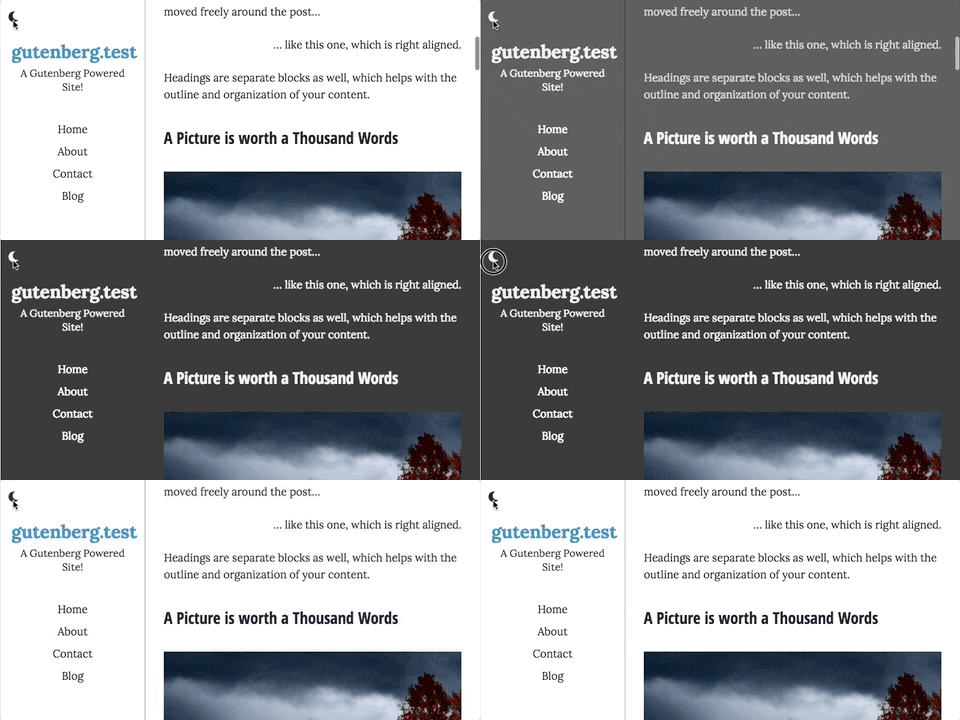
    • Night Mode – Let visitors toggle night mode to make the page darken for low-light reading
    • Read Time – Display an estimate for how long an article will take to read
    • Article Progression Bar – Show a progression bar for how far you’ve scrolled in an article
    • Author Info – Choose whether to display the author picture, display name, and description at the bottom of articles
    • Post Meta Header – Display info such as author URL, comments, tags, categories, post time, and post date via shortcodes before articles
    • Post Meta Footer – Display info such as author URL, comments, tags, categories, post time, and post date via shortcodes after articles
    The sidebar header layout of the Malik Theme
    The sidebar header layout of the Malik Theme

    These features were built with blogging in mind. I use night mode on apps like Pocket and Twitter, and having the option available on a website is something that I would like to see more frequently.

    Night Mode is a useful feature for reading in a darkened room

    Speaking of Pocket, I appreciate how it gets out of my way while reading by hiding menus on scroll. Read time and progression bars are available to give an indication of article length, which helps me determine if something is going to be read right now or added to Pocket for later reading in the first place.

    The theme is still under active development, but you can see it in action right here on my personal site. If you want to try it out, you can get the code on Github. If you find a bug or have suggestions for new settings or features, I’m always looking to improve!

    Note: Gutenberg itself is in active development as well, so if you use this theme, be sure to watch it for updates!

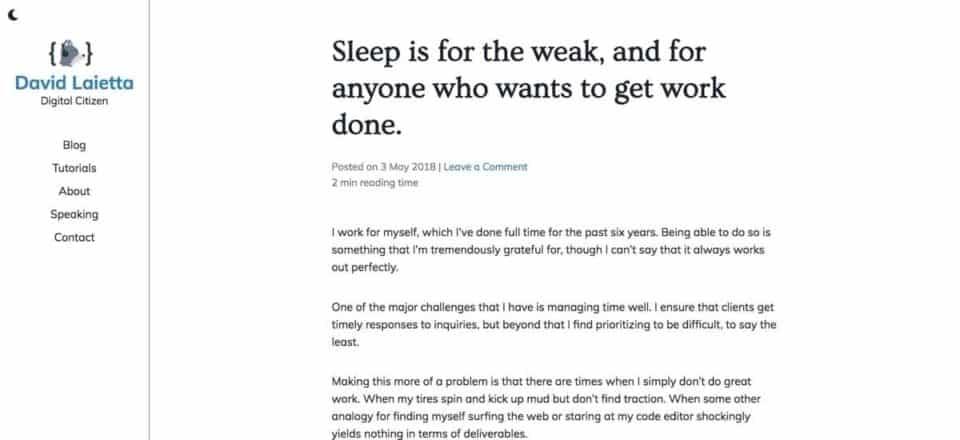
  • Sleep is for the weak, and for anyone who wants to get work done.

    I work for myself, which I’ve done full time for the past six years. Being able to do so is something that I’m tremendously grateful for, though I can’t say that it always works out perfectly.

    One of the major challenges that I have is managing time well. I ensure that clients get timely responses to inquiries, but beyond that I find prioritizing to be difficult, to say the least.

    Making this more of a problem is that there are times when I simply don’t do great work. When my tires spin and kick up mud but don’t find traction. When some other analogy for finding myself surfing the web or staring at my code editor shockingly yields nothing in terms of deliverables.

    Again, thankfully I can handle those times, professionally at least. Sure I may work slower on projects than I might otherwise, limiting the returns that I can get, but I work on my own terms darnit! I get to direct the course of my life and make that mythical work-life balance a thing.

    Except I can’t, because I carve out time for myself, but usually define that as time that I can be heads down on a project without having to worry about some other tasks that need to be done. The list of client deliverables is never ending, and when they are all satisfied the list of my own projedcts is even longer and growing.

    Being tired can be a beast. The kind of tired that keeps you from doing your best work, but also the kind of tired that keeps you from focusing on work in the first place. Where anything that is not an immediate deadline gets pushed off because the mindset isn’t there. Where you lie down to take a quick nap and wake up more tired than before, or don’t even fall asleep in the first place.

    I’m mainly writing this because at least five nights in a row I’ve been unable to sleep well and told myself every day that I’d be so tired come night that sleep would naturally come. Last night might have finally been the first restful night this week, after an hour of tossing and turning first.

    Honestly I’m just jumping back into blogging as a rambling exercise in moving some of the thoughts that concern me out of my mind and owning up to them publicly. I do have some tools and tricks that I use to keep myself engaged that I’ll write about this month, but I wanted to start by acknowleding that with the best of intentions there are days that I have little to show and don’t even feel rested when they end.

  • The Difficulty Level of Becoming a Web Developer is Growing

    The Difficulty Level of Becoming a Web Developer is Growing

    I know it’ll be odd coming from someone who yesterday made a commitment to daily blogging, but I’ve been overwhelmed with tech for a while now.

    Part of it is the endless news cycle, both about and enabled by technology. Part of it is the way that it can feel like an entire day is spent online, and not a single thing of value has been produced, and not a single person helped by my presence. But the biggest part is that diving into new web development has become a greater challenge than in the past, and we are dangerously close to cutting off the hobbyists, tinkerers, and dreamers who built the web up to what it is today.

    I’ve been spending time playing around with and building things for Gutenberg, the new content editor coming to WordPress. I’m doing this to stay up to date on tools for the WordPress Orlando Meetup and other events, like the Winter Park Blogging Meetup that I’m presenting at this afternoon. I’ve also been doing it because I know that new tooling means new opportunities when it comes to delivering products to market.

    My first dive into Gutenberg was the theme that my site now runs on, and which I’ll document a bit later this week. I worked on that while taking Zac Gordon’s Gutenberg courses, which give a good overview of how it currently works as a plugin and the way to start building your own blocks. Some of the first ones were easy, but getting into more complex blocks require more effort.

    It’s the glut of technologies that make this exhausting. While Javascript has been something that we’ve been exhorted to “learn deeply” for the past few years, that isn’t necessarily enough direction. Javascript itself isn’t enough, as there is a lot of tooling that goes into modern frontend development.

    I began learning about JS management with a presentation on Grunt. By the time I got to that there was a debate on if it should be replaced by Gulp, and by the time I got serious about using any in my workflow, Webpack became both the new hotness, and the standard that many Gutenberg contributors have been using.

    But it’s not so simple as learning Webpack alone. Have you started with Node? NPM? ESNext? What about React itself, which is tied with Vue.JS as the popular frontend dev library to make Gutenberg blocks.

    The point is that if you want to get started, there are plenty of resources and paths that you can take, so many that the hard part now is determining what to use and how to best apply it to what you want to learn and make. I’m in that process myself right now, and it is mentally draining.

    There need to be alternatives that allow someone brand new to web development to come in, start writing code for free, and share them with the world while learning and growing. Thankfully there are organizations like Glitch which are trying to do exactly this, and I intend on highlighting them and others in the future.

  • Making a Commitment to My Blog

    I regularly tell myself that it’s time to blog again. All I need to do is write more of what I’m thinking, share more tutorials, and develop content around what people who hire my company might want to see. I need to prove value to get people to pull out their wallets, and a personal blog about some of my favorite movies and a few scattered year in review posts doesn’t cut it.

    Just typing that last paragraph took me longer than I anticipated. I can spend lots of time scrolling Twitter and firing off responses, quickly exceeding the length of a post like this, but the concerted effort of all of my attention onto one topic is still challenging.

    While managing clients I deploy checklists and reminders, workflows and best practice lists. I have a process for most steps of the business, and I am able to ensure that work doesn’t fall through the cracks and become forgotten, and that if I have to do something more than once, it’s written somewhere.

    Doing the same when it comes to my own production – namely content and code – proves more complex. After all, writing this blog post is taking up time and mental resources, and I can’t guarantee any return on the effort.

    This is where I need to consider the future. How often have you said to yourself that you need to restart your blog, or build a new website? How often does that internal reminder go unheeded, leading to more broken promises to yourself?

    For me, that’s all the time. Of course, had I taken the effort every one of those times to write something and hit publish, I’d have a longer backlog of work available. As is, I’m making myself a commitment, and posting it publicly. One new blog post every day for the entire month of May.

    I’ve heard that to stick with a habit you need to maintain regular practice. Usually the advice given is somewhere from one to three months, but the advice is the same: just do that thing every day in that window. Big or small, if you make a point to remember to stick with your task, it’ll eventually become habit.

    I’m not sure how long it takes to make a habit to keep blogging, but my goal for the past few years has been to shift over to creating and distributing content. Working with WordPress professionally for a decade has given me plenty to write about, and it’s supplied the majority of my income in that time. That’s where some of my focus will go, as well as whatever academic takes I can have on the internet in general, and how we all fit into it.

    This is my promise, surely not the first like this that I’ve made and not the last. But by putting it out there I’m allowing you to hold me accountable. Do you want to get into blogging, or ressurect a defunct blogging experiment? Let me know where to find you and I’ll keep up with your work too. We can keep each other in check, and keep one of those personal promises.

  • Books in Review, 2017 – Technology

    Books in Review, 2017 – Technology

    In the final day of reviewing the 54 books that I’ve finished so far in 2017, I’m talking about books focused mainly on technology. I work in tech, I talk tech all the time, and one day I want to be known for writing about tech too.

    In the Beginning…Was the Command Line

    Neal Stephenson is an acclaimed sci-fi author who invented some of the terminology of the Internet. He is also picky when it comes to his operating system and computing features, as all good technologists are.

    This book ends up reading more like a history of Stephenson’s use of operating systems and hardware than a history of the OS, but it is still interesting if tinkering with machines is something that you like to do.

    Irresistible: The Rise of Addictive Technology and the Business of Keeping Us Hooked

    Why do we seem unable to put down our phones, or check them hundreds of times per day? They were designed with that goal specifically in mind. Learn some of the tricks used to make technology addictive, and keep yourself from being unable to go a few minutes without a notification check.

    Information Doesn’t Want to Be Free: Laws for the Internet Age

    In addition to being an excellent novelist (see Walkaway from Wednesday’s fiction post), Cory Doctorow works at the EFF and writes cogently on digital culture and the ethics and legalities around it. In Information Doesn’t Want to be Free, Doctorow examines and disputes a common rallying cry around Open Source and Free Software, and points out the fact that those creators deserve just as much support – if not more – than the larger companies that profit from their work.

    If you are a digital creator I highly recommend this book. If you are a person who cares about the Internet, I highly recommend all of Doctorow’s works.

    Utopia Is Creepy: And Other Provocations

    The Shallows: What the Internet Is Doing to Our Brains (audiobook)

    Both of these books are by Nicholas Carr, and both concern the Internet and technology. Utopia is Creepy is a collection of posts from his blog, which means that the quality of each essay varies a bit, and are rooted in a particular time.

    The Shallows is a more traditional book, with a focus on how the Internet is changing how we think. It is not necessarily an indictment of our current culture, though any book like this invariably gets to that point. Instead, Carr contrasts how we gather information as compared to other times in history, such as the amount of attention devoted to consuming a novel or research paper. It’s a good reminder of how we are shaped by technology, and how we have to choose our responses around it.

    Iterating Grace: Heartfelt Wisdom and Disruptive Truths from Silicon Valley’s Top Venture Capitalists

    Short book. Weird book. Weird back story. I can’t say this would get that far were it not the real life mystery that accompanied the distribution of the original 140 copies and the hidden nature of the author.

    Bit by Bit: How Video Games Transformed Our World

    A fun history of the video game industry, going back to before there even was one up to the present day of AAA title studios and independent game makers. Andrew Ervin has similar tastes in games as art as I do, so it was also enjoyable to read about games that I enjoyed from someone who got the same emotional tug from them.

    The Inner History of Devices

    Sherry Turkle has been studying the anthropology around humans and technology since before I was using computers. Her books are generally written for an academic audience, but they contain a deep level of knowledge and insight.

    The Inner History of Devices is Turkle’s attempt to narrate from the point of view of the device itself, and how interactions with humans work. An interesting read which taught me a few things, though didn’t change much of my thinking.

    I used Amazon affiliate links to link to these books. Start reading one today!

  • Books in Review, 2017 – Autobiographies and Biographies

    Books in Review, 2017 – Autobiographies and Biographies

    Today's books are mainly autobiographies, with one biography tossed in. I generally prefer autobiographies since they are direct from the source. While they lack the detachment and long view that a biography might possess, memoirs and personal accounts feel more visceral and real to me.

    Crash Override: How Gamergate (Nearly) Destroyed My Life, and How We Can Win the Fight Against Online Hate

    Zoë Quinn has been through a lot. As the genesis of the harassment campaign that became known as Gamergate, Quinn has the unenviable position of being the first to experience that particular group of hate, and the person who was used to launch a variety of alt-right (Nazi asshole) personalities into public consciousness.

    Quinn is self deprecating, maintains a good sense of humor throughout the ordeal and book, and offers useful tips for those who are currently being harassed, as well as preemptive tips to avoid some of the fallout of holding opinions that Internet harassers disagree with.

    The Bassoon King: My Life in Art, Faith, and Idiocy

    Of course Rainn Wilson first popped onto my radar with The Office, but I later followed him to his web company, Soul Pancake, where I watched a bunch of their Youtube videos. I was a bit surprised that the the serious Dwight and the unhinged vigilante from 'Super' was a generous and sensitive person.

    Wilson's memoir is that of a boy living around the globe in a variety of strange circumstances, growing up without realizing that acting was his passion until he dove headlong into schooling and auditioning, finally landing his defining role. Throughtout he practices his Bahia faith and describes how he lives with the world around him.

    Estranged: Leaving Family and Finding Home

    I chose this book because it is in part a decision that I made and I want to see how and why someone else has done the same. Jessica Berger Gross has a different story than I do, and I'm sure everyone does, and she has made her decision as more of a necessity than I have.

    One of the societal assumptions that I have been rebelling at over the last few years, and even moreso this past year thanks to the cultural shakeup that we've been having, is the need to do things because "that's just how they are". The problem with society though, is that it's social. I'm lucky to not have to explain my actions regularly, but it's a bit odd feeling that all of culture is against you.

    I contribute a lot of this being one of my best years yet personally to my decision to eschew norms a bit and make my own decisions. It's not always the easiest, but I don't regret it.

    An Unexpected Twist

    Andy Borowitz is a funny writer, and he handles the recounting of a life-threatening medical condition with the same level of humor as his New Yorker writing. This was a short read, and wouldn't have been quite so funny had it not had a positive outcome, but I enjoyed it.

    Man's Search for Meaning

    Victor Frankl's memoir of his time in concentration camps during WWII is brutally honest, yet meditative. He descsribes horrors as seen from the victims, while retaining humanity and a sense that there is purpose to everything even in his darkest hour.

    This book is recommended reading for a reason. You can live through hell and come back stronger and with more focus on your life. Additionally, you can have an account from someone about an atrocity that most certainly took place, while people who want to do it again deny its very existence.

    Notorious RBG: The Life and Times of Ruth Bader Ginsburg

    Ruth Bader Ginsburg has had a notable career, and is particularly outspoken and thought provoking in her words and writing. Ginsburg fully leans into the popular culture representation of a badass who doesn't take lip lying down. At the same time she professes undying love and devotion to her husband, showing that feminism doesn't equate to man-hate, but equity for all people.

    Alan Turing: Unlocking the Enigma

    While 'The Imitation Game' had historical inaccuracies, what biopic doesn't? Alan Turing was the father of modern computing, and a martyr that serves as a reminder that we often try to drag our brightest minds down when we don't recognize that what makes them different is what makes them important.

    This short recounting of Turing's life and professional work is a good overview of how he and a team helped crack the German Enigma code, while not giving him all of the credit like some other portrayals inaccurately do. He thought in terms far beyond what most people were doing at the time, considering computing as a platform for the future, not just the problem at hand.

    I used my Amazon affiliate account to link to these books. If you want to buy any of them, I wouldn't mind if you gave me a click!

  • Books in Review, 2017 – Fiction

    Books in Review, 2017 – Fiction

    Today is a focus on the fiction books that I read this year. I read more fiction than I have in the past few years, as I got stuck in the rut of assuming that only non-ficton was worth the majority of my time. Stories, even those not based in fact, are useful thinking tools, and just plain entertaining.

    Stone Mattress: Nine Tales

    Margaret Atwood has been one of my favorite authors since I read The Handmaid's Tale and Oryx and Crake in high school. She is a no-nonsense writer, both in her books and in real life. While painting vivid pictures of the worlds that her characters inhabit, she does not waste words.

    Stone Mattress is another short story collection of hers, with several stories sharing related characters, but all sharing a similar theme. The stories do not move so far out of the realm of reality that you couldn't feel them happening around you.

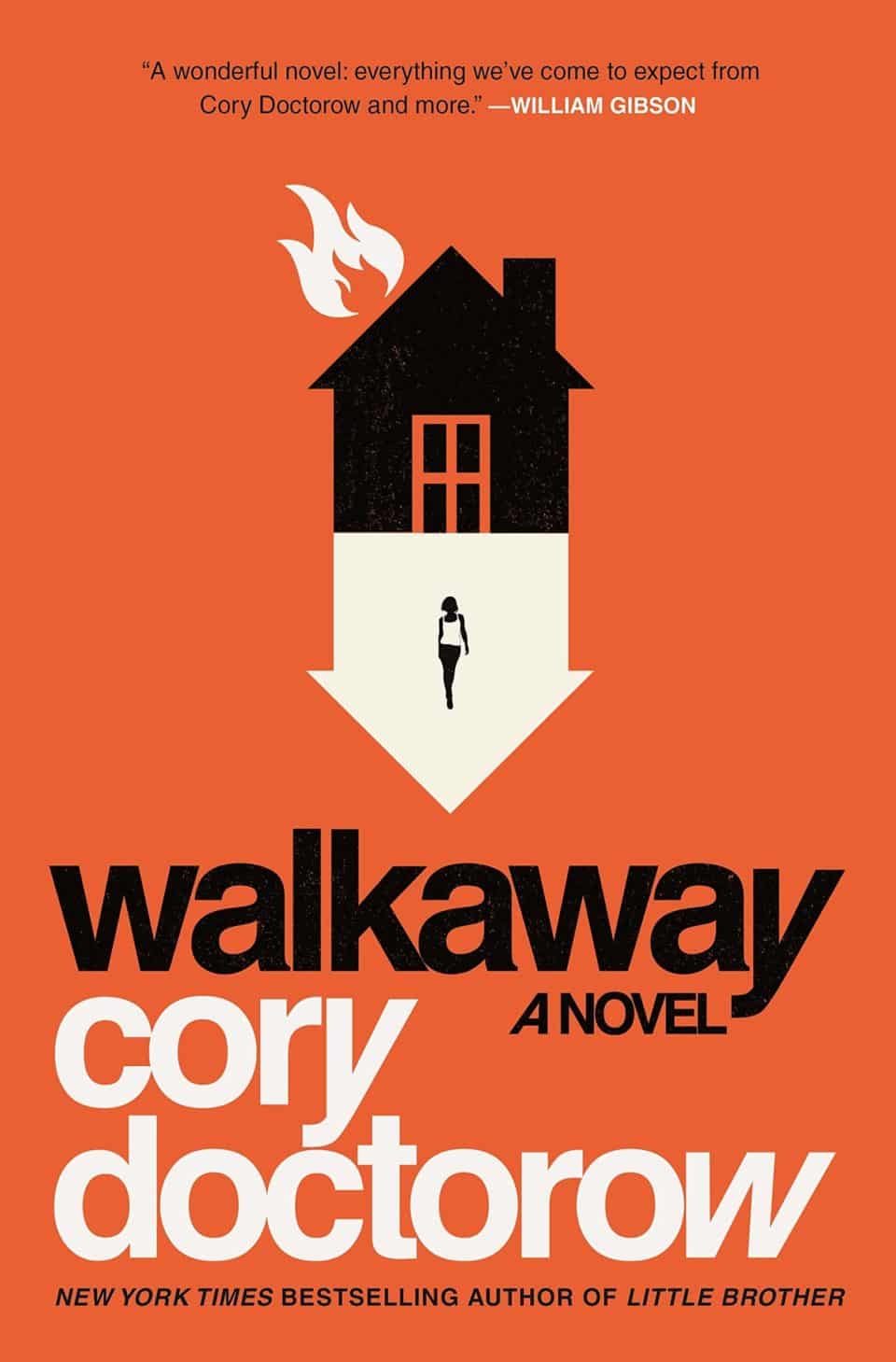
    Walkaway

    One of the best books that I've read this year. Cory Doctorow always has the ability to make believable worlds out of the unbelievable, showing how we could move from topical arguments of the day into unknown territory.

    Walkaway concerns a new mode of living in a world where tech has gotten good enouhg at repurposing waste that a freegan lifestyle is not only possible, but an attractive alternative. When it's cheap or nearly free to produce food and goods but copyrights and patents on their designs and processes stop them from being shared freely, class inequality is brought to extraordinary levels.

    I don't want to give away the plot, but suggest that anyone who thinks things could be different or better without going into purely dystopian territory as so much hard sci-fi seems to do, this book is worth reading.

    When everything is burning down around you, will you make the decision to walk away?

    Mr. Penumbra's 24-Hour Bookstore (Mr. Penumbra's 24-Hour Bookstore, #1)

    I wasn't quite sure what I was getting into when I started this book. Secret societies and codes based on a Borgean library nestled in a San Francisco bookstore? The book has this and more, and is intriguing to the very end.

    Mr. Penumbra puts a bit of focus on technology, archiving, and the value of knowledge while contrasting the time consuming process of working your way through hundreds of books while a computer and the resources of Google can handle thousands or millions more in seconds. The book shows that there is still room for human ingenuity among machines, and the narrative within a narrative structure gives me hope in the end.

    You

    Gamers and developers will get a special pleasure from this book. The main character is working as a developer for a game company that his friends founded as he split off from them after high school. He returns after the death of one of the co-founders and the failure of other career prospects. The book splits between in-game discussions of the characters that he designs and plays, reminisces of their shared childhood, and the struggle of keeping a AAA game company afloat.

    Ender's Game (Ender's Saga, #1) (audiobook)

    Speaker for the Dead (Ender's Saga, #2) (audiobook)

    Xenocide (Ender's Saga #3) (audiobook)

    Children of the Mind (Ender's Saga, #4) (audiobook)

    I read at least a dozen of the Ender books years ago, and wanted to return to them to remind myself of what kept me captivated for so long. While I find Orson Scott Card maddening at times as a person, he puts such humanity and insight into his characters that I wonder how it can be the same person.

    I chose to listen to these books to make it a bit more of a passive process, and I'm not sure if that helped or hurt as I moved along. The first two books are my favorites, but the third and the fourth are a bit maddening in a way that had me wanting to skip past portions if I could. The story seems to slow down, and things that I found clever and insightful a few years ago now seemed to come from someone with a particular axe to grind yet a disinterest in offending.

    I’m continuing on with this series and will be moving onto the Shadow Saga after I finish the interstitial books here. I only hope those ones hold up to the fond memories that I have on what I considered an insightful and clever look at religion and geopolitics.

    Freddie and Me: A Coming-of-Age (Bohemian) Rhapsody

    I don’t think I’d loved any artist the way that the author loved Freddie Mercury. I have an affinity for david Bowie, but not on as deep of a level and not from such a young age. It makes me feel like I’m missing something, not having a measuring stick that I can put up to my life as a reminder of how far I’ve come.

    Fahrenheit 451 (audiobook)

    Another classic that felt important to return to this year. The most shocking part of this novel that I’d somehow forgotten is the act of the firemen and how it is directed. It was not the government putting dissent aside as in 1984. It was the general population deciding that they did not want to allow dissent to cultivate. Books aren’t illegal because some Big Brother told us they were. It’s because we mutually decided to make them that way.

    Whenever someone says “The government is doing this”, what they mean is that there’s a comfort in being the victim to a larger evil, to spare the thought that it is the society that you are surrounded with that is that government. There’s no us and them, just the us that has been raised up high enough to speak for the rest of us.

    Beowulf (audiobook)

    One of the earliest of Old English tales, and the basis for many later stories. This was shorter than I expected and an easy read. Beowulf kill Grendel. Beowulf kill Grendel’s mother. Spoiler!

    Siddhartha (audiobook)

    Treated as a religious text, there is a bit of the tone here that bothers me. I don’t want the stories of fallible figures who have some of the same flaws that I have. I want to look towards a religious figure to be raised above human flaw and not used as an excuse for poor behavior. Siddhartha may find redemption in the end, but he has no struggle or sacrifice, he simply nothings his way into being the most holy doer of nothing.

    Siddhartha read a lot like business parables to me, along the lines of “The Go Giver” with a bit of misogyny and racism sprinkled in. It’s not terrible, and deserves some of the praise that it gets, but I don’t want to breathlessly condone a text just because the ascetic characters are considered the most holy without any reason.

    Norse Mythology (audiobook)

    Listening to this book read aloud by Neil Gaiman was a treat. He has a warm tone that lends an air of gravitas to his writing. The stories that he tells are simple, in that they are the start of all things, and in this case the end of them as well.

    Odd and the Frost Giants (audiobook)

    After listening to Gaiman’s book on the overarching Norse Mythology, I moved into this story about an individual human named Odd and how he used his unique position to best the Frost Giants after they overtook Asgard.

    Dead Trees Give No Shelter

    I wasn’t sure what I was going to get out of this short by Wil Wheaton, and I wasn’t quite expecting the ending. He is a pleasure to read and listen to on his blog, and he is a pleasre to read stories from. Give this a go if you are a fan of his voice or want to see what King Nerd is like.

    Mercury

    A clever little story that combines a past and present story into one narrative about secrets and darkness. Hope Larson is a great writer and artist, and her talents are on full display here.

    Original Sin

    I wanted this to be a good murder mystery, but it went a bit too out there and retconned too much to fit a specific narrative that I could not enjoy Original Sin. You get most of the Avengers throughout this storyline, but ineffective at best, standing around debating poorly at the worst.

    I used Amazon affiliate links for the books above. If you want to read any or get any other suggestions, let me know!

🌙 ☀️