Category: Thoughts

  • Maintaining Personal Life, Community Involvement, & Networks

    This post came at an opportune time, as I was invited to participate in Digital Orlando 2016 happening this week, to sit on a panel and discuss community engagement. Outside of work, I lead the WordPress Orlando user group, and am one of the organizers of WordCamp Orlando, having been involved with that organization for nearly the last five years. The community is probably one of the greatest discoveries that I’ve made in my life.

    A Very Limited History of david and the Web

    I’ve been doing web development since middle school, where around 1999-2000 I discovered HTML. From what I can remember, inline properties were still the way to go. CSS2 was just approved and published at that point, and most guides (and the class that I took that got me interested) were using things like this to center and bold text on a page:

    My site is so awesome!!!11one
    My site is so awesome!!!11one

    Oh, did I not mention the marquee tag? It was pretty awesome; the height of cool for your personal site in the late 90’s/early 2000’s.

    Anyway, away from that tangent, I didn’t start interacting with other people about websites until I started building some for clients. I think around 2004 is when I first got paid to build a website for someone, and I honestly wish that I’d kept better records to show it off. When I first started my web development career (working my way through college but still looking toward the future) I hadn’t even heard of WordPress or other CMS’. I didn’t start using WordPress until early 2008, so think of my earlier, pre PHP and DB based sites as proto-david.

    Even after moving onto this platform with a famously charitable community, I wasn’t aware that it existed for another few years. Sure, I used the support forums, but even I was late to the game of correlating text on the screen to real people behind those handles. It took a while to get involved, a bit longer before I met any of these people in person, but then a quick take off when I realized how awesome it was to regularly converse with people who shared a passion with me online.

    Enough Tangents, What About Me?

    Right, so should you be involved in communities around your interests? The short answer is yes. The slightly longer answer is yes yes yes!

    I absolutely credit much of my professional life and personal successes to the people that I choose to be around, and the time that I devote to helping those communities in any way that I can. I’m not going to write a long post about the many ways that you can give back your time, but suffice it to say if you’ve learned something from someone else, you have something to teach yet another person. A lack of confidence is the biggest reason that I get from people who tell me why they don’t get more involved, even more than a lack of time.

    When you demonstrate that you are offering up even some of your time, expertise, or experience to other people without the expectation of anything in return you demonstrate that you are interested in an ecosystem and not just yourself. By being involved you’re absolutely improving yourself by improving that ecosystem, but it won’t be seen as a purely self-serving gesture.

    As an example, I’ve gotten paying clients who I’ve given free help to at Happiness Bars at WordCamps (basically help desks for WordPress problems). The conversations all went the same way: “Here’s a fix to the problem that you’re having right now. If you have questions later, feel free to email me.”

    Note that in the prior example I did not offer paid services or suggest that I was offering subpar support to a free question. I try to do the best that I can in the limited environment there, and make the offer that if the person that I’m helping has questions later (they will) that they can reach out to me for more help, again free. If it is a complex problem, site build, or something that would take me a half hour or more of work, I suggest that it’s a problem worth hiring for.

    How Do I Get Started In a Community?

    First, repeat after me: It’s never too late!

    If Erik and Xavier can change later in life, so can you.
    If Erik and Xavier can change later in life, so can you.

    There’s always that worry of “Am I too late for this? Did I miss the bus and the opportunity to make money?” Which can be a valid concern, but not here. There are always new people entering a community and older folks leaving. Even if you choose a network or community on the decline, you can follow other participants to the next network and be on the ground floor there. In my case, WordPress is definitely still a viable community to get involved in, with profitable businesses starting up every day.

    The way to get started is to find where the people that you want to interact with hang out. In my case it’s Twitter, Meetups, WordCamps, and the make.wordpress.org community. Do a quick search for the thing that you’re interested, and it’ll probably be easy to make a connection to where the people that you want to network with in that field hang out.

    After you find the place to be, enter with an open mind. You don’t know everything (that’s why you’re there, right?), so don’t act like it. Be ready to learn, and ready to share. By virtue of your presence, the network that you’ve entered has grown more connected and has a new viewpoint to share. You know something that those around you don’t know, and you can likewise share with them as you learn from them.

    What About Personal Life?

    Right, I guess I did mention that in the title, didn’t I?

    This section is intentionally shorter since I think that these are more straightforward lessons. Use some of this time that you’re creating for yourself. I love the internet enough to make a weekly newsletter about it, and I literally bring my work home. I also make time for myself and for those around me. I take walks, play some video games, read often, and go out to lunch without notifications on my phone or my laptop in tow.

    There’s a finite amount of time available for all things, and I block work into times convenient for me. I guarantee that however hard you are working now, you can cut a few hours off of that work time and be just as productive. I’m certainly not a poster child for this, but I’m trying to get better. Using tools like in the previous posts in this series help cut down work time while producing better work. That sounds like a win for myself and my clients alike.

  • Tools and Techniques That Have Improved Development Tasks

    Tools and Techniques That Have Improved Development Tasks

    Next up on my run-through of things that have improved my workflow is development tasks. This is one area where I know that I need a lot of improvement, as there are so many tools out there.

    Starting Projects

    I typically begin each WordPress based project via Vagrant and a VVV box on my local machine. We did a meetup on this and other local development environments last month, and some notes and links can be found on our recap post.

    I started using Brad Parbs’ excellent addon Variable VVV, or just VV. It’s made creating new development sites even easier, and adding blueprints on top of that have made it even even easier. For instance, this basic blueprint installs the Genesis framework, installs a Genesis child theme that I made that is in need of update, activates that child theme, installs Gravity Forms, activates and licenses it, installs and activates Jetpack, and loads some test content from wptest.io so I can see how the site that I’m creating looks with various content. Not bad for what becomes a one line command!

    {
      "genesis": {
        "themes": [
          {
            "location": "An up to date Genesis Zip",
            "activate": false
          },
          {
            "location": "davidwolfpaw/obm-genesis-child",
            "activate": true
          }
        ],
        "plugins": [
          {
            "location": "An up to date Gravity Forms Zip",
            "version": null,
            "force": false,
            "activate": true,
            "activate_network": false
          },
          {
            "location": "jetpack",
            "version": null,
            "force": false,
            "activate": true,
            "activate_network": false
          }
        ],
        "options": [
          "current_theme::obm-genesis-child"
        ],
        "demo_content": [
          "link::https://raw.githubusercontent.com/manovotny/wptest/master/wptest.xml"
        ],
        "defines": [
          "WP_CACHE::false",
          "GF_LICENSE_KEY:: My Gravity Forms License Key"
        ]
      },
    }


    The most important thing for me is that I have things to start with. VVV and a starter theme or plugin do more for me than just save time. They also save mental energy and keep me away from that dreaded blank page that makes even simple projects more daunting. With a starter I feel like I’m half done when I get started, because in essence I am. Every project doesn’t need a complete rewrite, and the time and energy saved can be better put to the specifics of this one project.

    Maintaining Projects

    I’ve been getting better at committing code to a version control system for every project. I’m still working on most things solo, but when someone else needs to jump in or review, it’s been a big help, at least in making me look more professional. For clients we use Bitbucket, but in general I’m going to start posting more things up on Github. I’m at least going to put up a gist library of common code snippets that I use and reuse with lots of projects, as that cuts down the amount of work and places where mistakes could crop up if I am constantly redoing it.

    I keep copious notes, often in Drive in a client folder, that I can review for later, as well as the tasks in Trello that I mentioned yesterday. Even if I’ve got a feature or change that I know is not coming up now whether through time or budget constraints, I prefer to keep it in mind so that it doesn’t surprise me later. Plus, there are often easy wins, like being able to reuse member registrations for one portion of a project for another, that can allow me to offer extra value to clients with little additional work. Writing something right the first time is a lot easier than writing it one way then having to shoehorn a feature in later.

    Conclusion

    I specifically didn’t go too in depth, because when it comes to tools, I mainly feel that what works for you works. I use Sublime Text as my editor, but there are a lot of great ones out there. I personally don’t really like using an IDE for general web development, and like the versatility and breadth of plugins that Sublime offers. I also think the process that works is the one that you stick with. Despite the things that I know that I need to get better about (setting up projects in Sublime, utilizing Grunt as a task manager, etc), I can still be productive and slowly add new knowledge over time.

    Do you have any specific tools or processes that have saved you lots of time or that you expect to save time in the long term? I’m always looking for ways to level up, so let me know!

  • Methods and Tools I’ve Applied for Organizing Communication

    Yesterday I did a meandering intro to the series for this week on personal growth and development and the tools that I use. I’m starting with communication in all of the forms that I have it, though some organization tools will creep in as well.

    Email

    I handle most of my email through the AirMail App (OSX). It allows me to connect a variety of accounts, has a clean interface that I can modify, exists outside of my browser, and has a few features like snooze and unified inbox that I really like.

    The tool isn’t the important part though, it’s how I handle it. I’ve begun limiting my email hours when I’m in heavy tasks, shutting down AirMail with dedicated check and response times at 10AM and 3PM. I’m taking baby steps on this, and again am only doing that while I’m in the middle of large work, though the intent is to build that into a daily habit.

    I don’t check email on my phone, and I’ve turned off all notifications for email across all devices. I stay near inbox zero daily, as even double digit inboxes scare me. I’ve not yet outgrown using my inbox as a to-do list, but I’ve been saved tremendously by Unroll.Me, a free service that allows me to bulk unsubscribe from email lists, as well as put unimportant emails into a “rollup”, which I can view at my leisure. This makes my inbox look less chaotic, and if I did have notifications on, I’d get far fewer in the day. This service is absolutely free. Use it and be amazed.

    Chat Communications

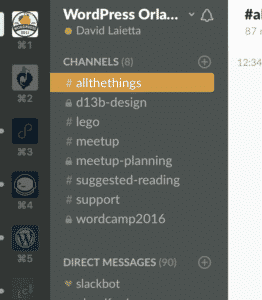
    I live in Slack most of the day. Their tagline is “Be Less Busy”, but the amount of communication that it gives me certainly expands the conversations that I have. That said, clarifications are more easily made, and communication is easier when it can be asynchronous but not tied to the formality that people expect of email.
    Slack Channels

    Social Media

    I spend too much time on social media. I don’t keep up with them very much, and I basically only have two active profiles, mainly Twitter. The reason I feel that I spend too much time on them is how ingrained they’ve become as habits, to the point that I don’t even think before opening a new tab and hitting “f” or “t” then enter.

    I don’t currently use any apps to manage posting, though I’m trying to get into HootSuite. I don’t use anything but the web apps to access either of these sites, though I do use Twitter on mobile frequently. I try to keep my following list down enough that I keep a semi-diverse but interesting feed, without having too many people that I have a very light touch on.

    Project Management

    I’ve tried at various times BaseCamp, Do, Podio, Asana, and probably others for project management. Each has pros and cons, but none really stuck with me. BaseCamp is the strongest contender for unused tools, though the monthly cost made it less appealing to me. Now that they’ve changed billing, we might start using it as a team.

    For now, the tool that I’ve stuck with and enjoyed the most is Trello. The card system puts everything in front of me in a visual manner that I enjoy, and I don’t feel bad spinning up a new board (Trello’s structure for projects) for new ideas. Trello is another tool that is free and has changed up something fundamental in how I work, and I highly recommend you look into it even for organizing your personal life, as I do with a few boards. Pairing it with Google Now lets me add cards to my to-do list with voice commands, which is the only way I’ve kept from forgetting so many tasks.

    Document Management

    Document management is a simple decision process for me. Is this a text document or spreadsheet? It goes into Google Drive, so I can edit it online from any device. Any other file goes into Dropbox, so I can be sure that I’ve got some backed up copies of it. Both tools I use the free versions of, though I also use paid Google Apps for the business. Dropbox for Business may be a purchase this year, as sharing specific folders with clients would be great. I prefer this to a service like Drive or Basecamp for individual files, because I get to skip the step of having to download the file and move it somewhere, as it’ll be automatically synced to my device. This is especially useful for code and the like, especially if it’s something that I haven’t made a git repository for on GitHub or BitBucket.

    Conclusion

    That’s my list, which I’m sure will be different from yours. Is there a communication tool that you’re really passionate about or that you think would save me time or mental energy? Please let me know in the comments!

  • An Intro to the Tools and Techniques that Transform my Work Life

    An Intro to the Tools and Techniques that Transform my Work Life

    I’ve been in a contemplative mood again recently. I still enjoy what I do, and am grateful everyday for the opportunities that have been afforded me, but I can’t help thinking of more. For me more doesn’t mean more money specifically, though it can certainly help to buy some of the things that I do want. The things that I want are freedom, purpose, and meaning.

    Again, I’m not going to act like I don’t already have a tremendous advantage by even being able to take the time to consider these things. Instead, I want to think about entitlement.

    Entitlement is like a slur, but it can be seen more positively as progress. I am entitled to a standard of clean and secure living that progress in the USA has brought. I am entitled to a communications platform that has reshaped humanity more rapidly in a few decades than centuries of slow developments before it because of progress in technology and cooperation among humans.

    All of this is a lead-in to my focus of the week, and for the posts that I’m publishing. One of my constant goals is “write more”. Scratch that. one of my constant wishes is to write more, but it’s not a goal if I’m not working on actually doing it. Sure, I’ve been keeping a regular schedule for the past four months at This Week in Web, but it doesn’t fully scratch the itch. I’m starting with an overview of how I manage my time and work-life currently, with the following posts this week:

    Tuesday: Methods and tools I’ve applied for organizing communication
    Wednesday: Tools and techniques that have improved development tasks
    Thursday: Maintaining a personal life, community involvement, and networks
    Friday: Habits and tools I use for continuous learning

    Even if you don’t end up using any of the tools or techniques that I discuss, I always think it’s worth introspection to consider what you’re doing. It often takes repeated suggestions for me to even look into something, and even more of a push to turn methods into habits. This week I aim to be part of that push for you.

  • Making My Goals More Useful For Another Year

    Inertia is hard to overcome; sustained change hard to enact.

    That’s what I used to think at least, and that’s what we’ve been trained to think when it comes to personal change. The pendulum swings to this from irrational optimism over how this year will be different, how this year you have what you didn’t last: the Plan.

    The Plan is that list that you make when you feel the need for change. You think “Hey, if I’m going to start a new business, I’m going to finally take those classes too, and finish that book, and go back to the gym, and eat better foods…” and on, and on. The Plan is the master list of everything that will be right with your life when you move from step one to two to three on an ordered path, and the only reason that you didn’t make salads for dinner before is because you didn’t have it written down here, for the world to see. But are those the things that you even want to do? Why?

    Tim Urban discussed this on his amazing blog Wait But Why in the series in which he discusses Elon Musk, Cooks vs Chefs, and the power of uncovering first principles by asking why. He discusses the bottom floor of standard reasoning, the “Because I said so” mentality that is trained in from asking the question of why too many times. This puts a limit on how far your reasoning can go, when the basic assumptions that you start with end up being based on flawed models. Why do I want to complete this project? Because that person will maybe notice? Why?

    I’m starting on another year of life, and I’ve made a great number of changes throughout the past year, but they have had less to do with a master plan (though I am guilty of writing these out from time to time) and more to do with tackling goals that are broken into smaller steps, one at a time.

    This post isn’t supposed to be all about promises, kept or not. A few more things that have stuck out for me over the past year:

    • I did a fair amount of traveling, though only in the US this year, and not as much as some years prior. This includes Miami, Tampa, and Fort Lauderdale in Florida, as well as Atlanta, Washington DC, NYC, New Jersey, Philadelphia, and Minneapolis. I’m looking to revisit most of these places this year, as well as a vacation to California to knock another one of the goals off of my list.
    • I spoke at a variety of conferences in most of those cities, including several WordCamps, BarCamps, meetups, and php[world]. I’m a big believer in sharing and learning through teaching, and am working on improving my public speaking skills.
    • I’ve successfully kept out of the 27 club
    • I kept myself gainfully employed while goofing off, and am working on strengthening my business.
    • I launched a newsletter to tackle another short term goal, and to help as a stepping stone to a mid-length goal that I created for myself a few years ago.
    • I started a new maintenance service for clients not requiring full site work, with the intention of offering resources to businesses of all sizes. Check out SiteHealthy (rebranded as FixUpFox in 2017), and if you know someone in need of the service, let us know and we’ll pay for the referral 🙂
    • I led WordCamp Orlando for the last time, passing the reins to Lisa Melegari, who has been instrumental in keeping the event going the past few years and keeping me sane even longer.

    I’m sure there’s more that I missed, and one of those goals that I spoke of is learning to keep track of things better (solving it in developer fashion with a plugin that’s launching next week). I’m looking forward to a bright and active 28, with lots of projects that I hope to share, both in the show-and-tell sense, as well as the freely distributed sense. GPLv3 and CC FTW!

    Do you have any new or old goals that you’re working on maintaining this year? Leave a comment, see if we can work on them together!

  • That Time That I Lived On The Internet

    That Time That I Lived On The Internet

    One of the things that I want to do is get better at producing content, and I’ve started a few projects to do just that in 2016. The first is a weekly newsletter for interesting stories about internet culture that I curate, the impetus of which I share below.


    Reposted from the launch post for This Week in Web

    I live on the internet. What some in the past would have said is to an unhealthy degree, even. Fewer people say that these days though, and not just because I make my living with the internet, necessitating a fair amount of engagement there.

    Clifford Stoll has already been picked on quite a bit, as the two decades since he shot down the idea of human contact becoming meaningful on the internet (and indeed the idea of meaningful anything on the internet), has been proven quite decidedly wrong. Even Clifford himself has acknowledged this, but you cannot blame him for that view at that time. Surely we cannot expect that the large machines that we are forced to interact with in the office, jealously guarded by the esoteric knowledge of the smug class known as “The IT Department”, connecting to other large machines via the arcane mysticism of many a bearded sysadmin would fundamentally revolutionize the way that we live, work, and play.

    But the revolution has indeed come, and we’re all currently feeling the effects of it. The struggle with what the internet does to us, as both individuals and as society, is ongoing and unrelenting. It seems unthinkable to suggest that the average person in a developed nation could depart from the internet, to the point that the UN has suggested that unimpeded access to the internet should be a universal right.

    This newsletter is an extension of my interests concerning the internet, and how it has changed how we think about the world and each other. Expect stories about internet subcultures, digitally mediated interaction, and the political and legal battles surrounding all of this. I dig around constantly for interesting stories concerning the internet, and will surface the most interesting finds every week via the newsletter.

    Do you have anything that you think I’d find interesting? Share it so I can include it!

  • Here’s to 2015!

    Here’s to 2015!

    It’s time for reflection! I’m home a bit sick today, but still scrambling to prepare for a new year. Go figure, I’m a day late on this. Like last year, I’m not going to focus on very specific resolutions though I’ve got a few things to work on in January. Some of this is a direct outgrowth of my personal growth planning workshop (that I would suggest all of yall undertake).

    One of my largest undertakings this year was in education. I finally registered at UCF to begin a second bachelor’s degree, and I’m working my way through the early classes now. It turns out that with a BA very few classes carry over to a BS, go figure. That means I’ve got a few freshman level classes mixed in with later classes for the first few semesters, which I suppose is a useful – albeit costly – ramp up. This and online courses dominated my formal and semi-formal education for the year, and it’s going to be interesting to see how I balance that and work in the coming years. At the rate that I’m taking courses it’ll probably still take me the four years to finish. I sometimes look at my plan and think that by the time I finish it’ll be a lot of money spent and being behind on knowledge again, but I keep reminding myself that if I don’t start now I’ll have the same complaint about being behind next year, only worse.

    I also started being more open and direct, as I’d felt that I was a bit more passive-aggressive in my dealings in the past, or haven’t been as clear when I’m having an issue, and hoping that things smooth themselves over without direct action. Turns out that they don’t generally, so I started stating cases for some reasons I don’t accept most partner offers, or why the general request to sign NDA’s that I receive in cold emails come improperly and don’t make business sense for me. I also worked on setting expectations with teams, a skill that I’m working on heavily still.

    I continued involvement with WordPress Orlando, and stepped down as lead organizer of WordCamp after my third run at it and fourth year of involvement in the group. I don’t plan on leaving though, and the team has already started sprinting ahead on WordCamp Orlando 2016. The meetup group is going to be my main focus this year, especially putting on workshops to help people build businesses with WordPress.

    WordCamp Orlando 2016 Stage

    I continued to watch lots of movies, both of the entertainingly satisfying type, as well as plenty of documentaries. I do want to write about what I read and watch more than I do now as a form of self-reflection, but this year I at least wrote about several movies about technology that reflected my views on digital privacy, rights to free speech, and some of the issues with the outmoded Computer Fraud and Abuse Act that still holds too much sway. I also enjoyed yet another Miyazaki film, and wrote about what ‘The Wind Rises’ means to me about passion.

    Also, a few weeks ago I finally wrote an imperfect form of a post that had been rattling around in my head since season two of Bojack Horseman came out, and I devoured it over the weekend of its release. Turns out I can be deeply affected by a cartoon. Maybe I need to focus more on consuming media that moves me to action?

  • Bojack Horseman – Silly Cartoons Are For Adults Too

    Bojack Horseman – Silly Cartoons Are For Adults Too

    Last week I started watching Netflix’s ‘Bojack Horseman’ with my parents. A friend who worked on the show suggested it when season one came out. While it took me a few episodes to get into it, Bojack quickly became one of my favorite shows of the summer, which was repeated this year when I watched the second season three times in the first two weeks that it came out.

    What is it about these adult cartoons that make them so captivating? The medium has been handling adult themes since it’s inception, but we still view most animation as geared toward children. Maybe it’s the subversion of a supposedly immature medium by adult characters who are more immature than Spongebob, Pokemon, or My Little Pony. Maybe it’s the puerile acts of Archer, Bojack, Peter Griffin and the like in a format that has been marketed as puerile from birth.

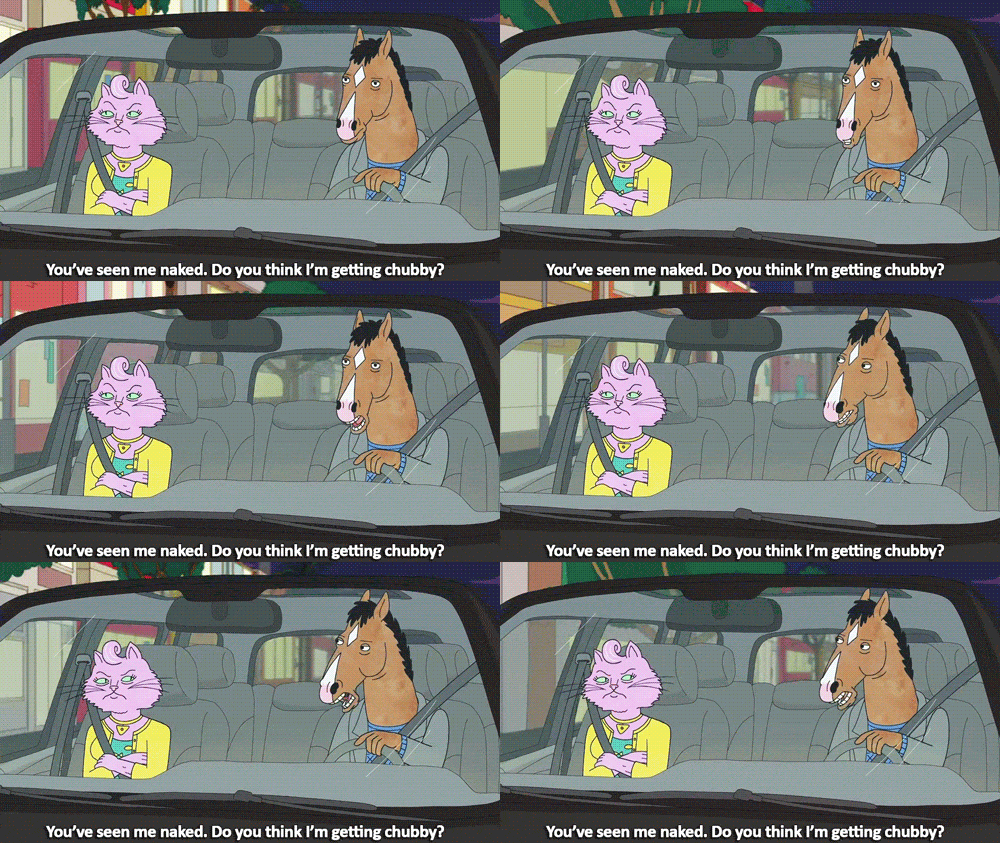
    Whatever it is, I can’t get enough of the antics of Horseman and his friends. There’s a certain way I can relate to the titular character and his companions. I’ve never been a multimillionaire sitcom star living in a mansion overlooking Hollywood Hills. Granted, I’ve also never been a horse, but that doesn’t mean that I can’t find some part of myself in him. See the next two images and judge me accordingly:

    Bojack Horseman Ate All of the Muffins
    Bojack Horseman and Princess Carolyn

    What really has me hooked though isn’t the lack of self control and self esteem, but the way that all of the characters find their own ways to cope with the world around them. While the common idea of LA being a place of constant grind and hustle wearing people down exists, that’s not what’s going on here. These characters generally appear to stumble into good fortune and work at every turn, even against their lack of effort. So what is it that is so hard?

    Bojack is regularly drunk, while his TV daughter is a washed up pop star who is the show’s take on Lindsay Lohan and other child stars trying to exist in a world that wanted them for what they represented, not what they really were. His agent, Princess Carolyn, tries to balance her own wants with the demands of her high paced job, best displayed in the dismal ending of season one’s “Say Anything”. Todd is generally blissfully ignorant, but clearly has family issues that he’s trying to resolve with the surrogate family that surrounds him, and Diane can’t resolve the fact that everything that she thought that she wanted isn’t all what it’s cracked up to be.

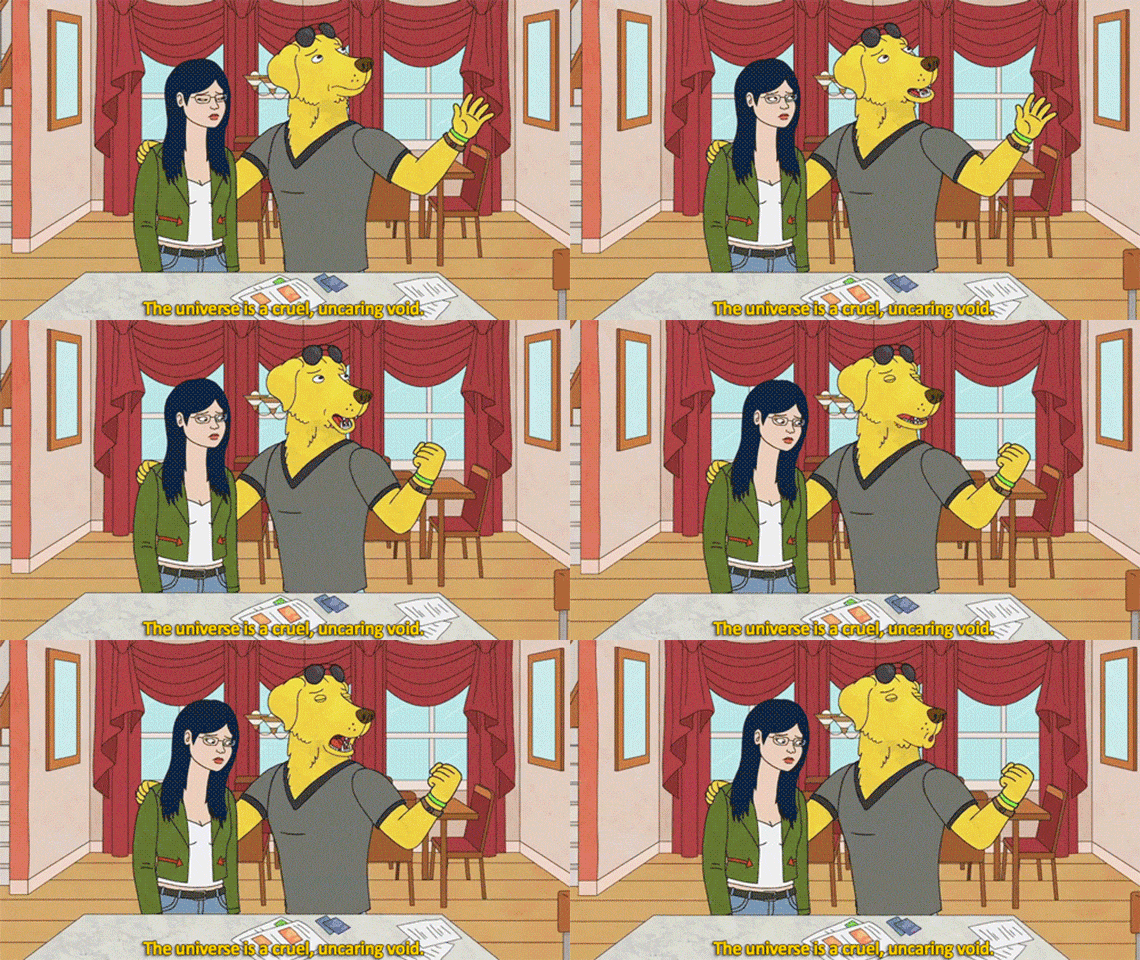
    The show doesn’t shy away from the inner lives of it’s ensemble stars. Even the eternal optimist, Mr. Peanutbutter, has moments of doubt, but ones that he never shows to anyone else. I can imagine this character having a lot more going on than he lets on to the outside world, even to his wife, Diane.

    Mr. Peanutbutter and Diane

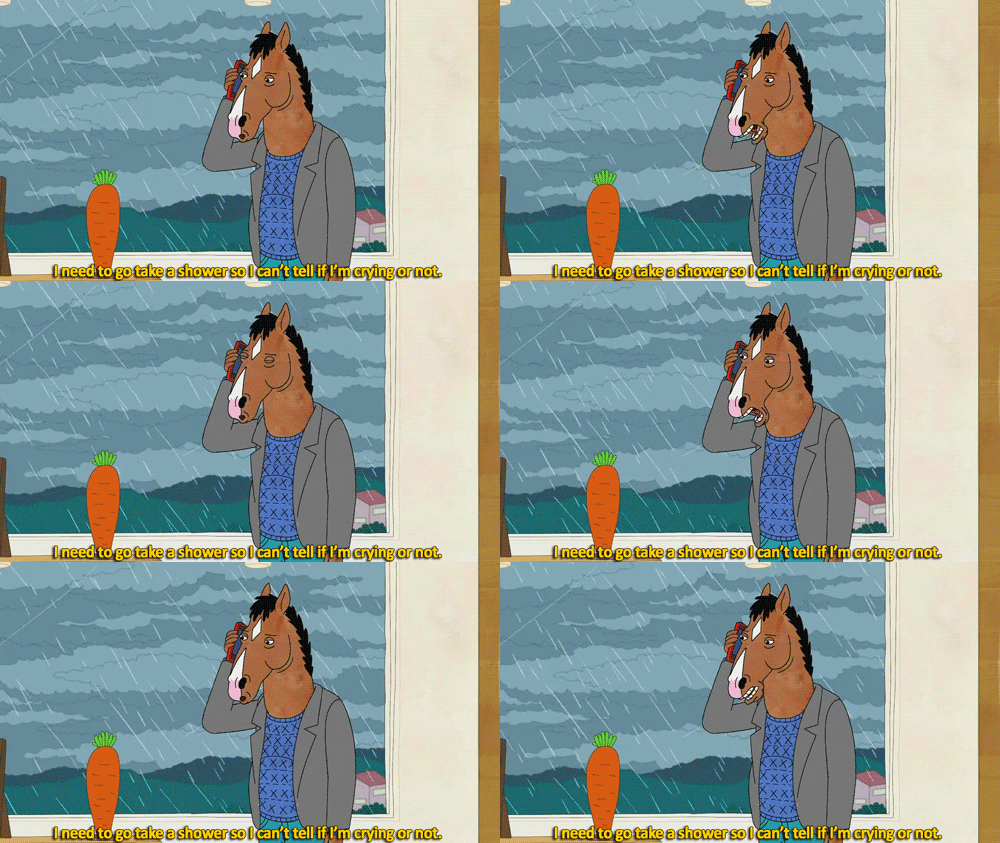
    Vulture called Bojack Horseman “The Funniest Show About Depression Ever“, which I find fairly accurate. The characters are a more realistic take on clinical depression and general malaise than I’ve seen elsewhere, while showing that being depressed can have light moments too, and isn’t just constantly moping around (though there’s plenty of that in the show, too).

    Bojack Horseman on Shower Crying

    There is some smart storytelling here. Even throwaway jokes end up returning as brick jokes later, like the broken bed frame and Gabe the Fire spreading out across two seasons. I can only imagine what animalized celebrity will come back in season three, or which visual gags from the most recent season will end up having larger story implications.

    The final takeaway that I have is how throughout it all, Bojack and his friends clearly want to be better. They may stumble and make mistakes and lean on what they’ve already known and comes easily, but moments of clarity come out that can be heart breaking. The show has made these deeply flawed characters entirely relatable and makes me feel like I want to become a better person too.

    It gets easier. Every day it gets a little easier. But you gotta do it every day. That's the hard part. But it does get easier.

    It gets easier. Every day it gets a little easier. But you gotta do it every day. That’s the hard part. But it does get easier.

  • Four Things ‘The Wind Rises’ Taught Me About Passion

    Four Things ‘The Wind Rises’ Taught Me About Passion

    Last night I rewatched ‘The Wind Rises’, an animated biopic about the early life of Jiro Horikoshi. Mr. Horikoshi was an engineer who designed airplanes, most notably the Zero Fighter infamously used by Japan during WWII. Like another Jiro that I wrote about two years ago, he had dreams of his work that led him to his passions.

    There were many negatives to Jiro’s work (which he famously acknowledged), as well as a long list of lives affected or ended by his creations. The story presented in the movie is not about these negatives or the moral dilemma of the subject. Instead it portrays a man driven by his passion, quite literally dreaming of amazing creations.

    thewindrises2

    I’ve taken a few key points away from the movie relating to how I view work and passion. I truly believe that the most powerful thing that you can do for yourself is to work on your passions.

    1. Start With Love

    The Wind Rises - Start With Love

    It’s tempting to look at what others are doing that seems easy or fun and decide to do it. It’s even more tempting when you can see people making a solid living in whatever industry you’re viewing and decide that you will do just as well. The real challenge is to avoid the temptation and instead focus on the thing that you can’t stop talking, thinking, reading and even dreaming about.

    If you can’t start with “love” then everyone who does love will beat everyone who “likes” or “hates”. 

    James Altucher

    The things that you love to do are those things that will carry you through when it gets rough. When you feel like you’re stuck in a rut and everyone is surpassing you and it’s not as easy as it initially looked. When you get so far down but don’t even question it, because of course this is the thing that you were meant to do.

    2. Learn From Your Mistakes

    The Wind Rises - Learn From Your Mistakes

    You will mess up. With any luck, you’ll mess up big time. If you do this and you keep going, you know you’re doing the thing that you love.

    I’ve made plenty of mistakes in my work, and continue to do so. The important thing is that I attempt to learn from those mistakes and mitigate them in the future.

    It is easy to screw up and give up, but why stop when you’re putting in your 10,000 hours on the way to mastery? Looking at it another way: I’d rather keep going than have to start over again somewhere else because I’ve made a mistake. You can’t gain mastery if you give up after your first setback.

    3. Do the Hard Work

    The Wind Rises - Do the Hard Work

    Passion is great, but sustained work is exhausting. There will be times when you question whether the love is enough to get you through. Those are the times that you need to dig in and focus on the hard work.

    Sometimes you have to do something that you don’t want to do on the way to your goals. Sometimes you have to work on or learn things that you don’t care about because they are stepping stones to the things that you do want to be doing.

    It’d be a lie to say that doing what you love means that you never get tired of it and never feel drained by it. The important thing, like sticking through mistakes, is staying the course even when the thing you love sometimes feels like the thing that’s killing you.

    4. Keep Dreaming

    thewindrises4

    Finally, don’t forget that love that got you where you are in the first place. Work will become stagnant if you don’t keep thinking of ways to expand and improve. You can become the best at the level that you’re at while still having people in front of you to follow.

    The nice thing about perfection is that it’s an impossible dream. The great thing about passion is that it doesn’t even consider that. It will drive you to strive for perfection, giving you new dreams of new things to get you there.

    Do you want to get better? Do you want to learn how to do something new? Take a hint from the first tip that James Altucher offers in the story that I just linked. Love it. Love your work, then follow the rest of the steps to get there.

  • Workshop – Building a Business with WordPress

    Workshop – Building a Business with WordPress

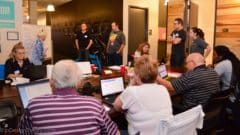
    Last weekend I hosted a workshop for members of WordPress Orlando where we worked on websites as businesses. The event was set up like a quicker Startup Weekend, where attendees pitched ideas and voted on them to work together in groups. At the end of the day, each group shared what they worked on and what they learned during the day.

    The goal was not to further the business of any one attendee, but to have everyone work together. We also sent attendees home with some cool tools, including a free year of hosting at SiteGround, to ensure that they had no excuse not to get started with their businesses.

    WordPress Orlando Business Workshop

    We gave groups a mandate not to focus on writing code, but instead look for tools that could help them out. This let us focus on the idea and a minimum viable product than on perfect execution, which is all but impossible in one day. They learned how to set up membership sites, newsletters, payment gateways, or even just install WordPress. They focused on the structure of a business model and website, not on the exact layout and design.

    I believe that empowerment is the key feature that WordPress offers. I’m always talking about the community and how important it is to be involved and how it helps raise everyone up, but empowerment is the reason for that community to exist. WordPress can make it easy for someone who is retired, between jobs, raising a family, going to school or already employed to start a new business or expand upon a hobby. Giving someone the option to start their own business without having to wait for approval or jump through a ton of hoops is a great way to get them involved in something fun that can produce tangible results.

    WordPress Orlando Business Workshop

    I would say that the event was a success overall. We had about thirty attendees stay the full day to work, and we rarely had to step in to help. I think that’s the best sign of success for me – that we were facilitators and mentors, not walking people through every step of the way. We’ve already had requests to do the event again, and I took copious notes on how to improve for the future.

    I can’t thank our awesome sponsors enough for the support that they gave us. I didn’t ask for money, I asked for tools for our attendees to take home with them, and did they provide! This is my blog, so I can put my affiliate code, but if you attended the event, you got some of these tools for free or at a heavy discount. 😀 Thanks again!

    • Director of Innovation for Orlando, Matt Broffman, came by to share with attendees his path to building Bungalower, a site that exemplifies many of the lessons that we aimed to teach.
    • Canvs donated space for our teams to work and eat throughout the day.
    • SiteGround graciously donated free hosting to all attendees and gave us some awesome notebooks for the event
    • StudioPress offered a discount on their themes, which I use for a lot of site builds.
    • Easy Digital Downloads  and iThemes offered a discount on their extensions to help users start an online store
    • CodeGuard and MainWP gave users free tools to help manage their sites and keep them safe and up to date.

  • No, “Your Content Here” Did Not Break the Internet

    No, “Your Content Here” Did Not Break the Internet

    I feel like it’s time for a bit of a rant. There’s a new phrase that I’ve begun noticing more frequently over the past year: that “____ Broke the Internet”. Fill in the blanks with whatever thing you deem important enough to command the intention of millions of people, and it is quite literally smashing the internet to pieces as we speak. When you have formerly reputable journalism organizations reduced to listicles to get readers , you have Time making a Top 10 Things that Broke the Internet retrospective.

    When you search for the phrase, the event that popularized and encouraged comparison of the term was Paper magazine publishing nude photos of Kim Kardashian last year. Paul Ford did a good, non-tech overview of how Paper worked in the week leading up to the release of the photos to scale their servers to handle the load. He spends a good amount of time talking about how their team wanted to ensure a high load of potentially hundreds of millions of viewers. They ended up being overly optimistic by a full order of magnitude, but did still have a highly discussed topic.

    Other events have come up that people claim “broke the internet”. Last week, a photo of a dress was posted to Tumblr, which became s viral phenomenon, being shared and discussed by millions of people.

    tweet from Taylor Swift about dress
    Even T-Swift had to weigh in

    Why is it that we’re so quick to describe something on the internet in such bombastic terms? If you think of certain websites and applications that are used by tens or hundreds of millions of people per day, you don’t hear people talking like that. Google and Facebook don’t “break” the internet every day while serving up content (including most of the content that is discussed).

    I think that it’s a shared cultural moment. There’s much talk about the media landscape becoming more fractured, with niches existing to please every individual taste. Up until the 2010 Super Bowl, the most watched television event was the M.A.S.H. series finale, barely missing maintaining it’s 1983 record of 105.9 million live viewers. A list of the highest attended movies of all time shows that you have to jump down to 2009’s ‘Avatar’ at #24 just to find a movie released in the past 15 years.

    Anything that can get a few million people simultaneously discussing it gives us a taste of that collective culture that we’ve lost. It’s a way to connect with other people reliably outside of standard small talk. The excitement of shared experiences with all levels of social circles is harder and harder to come by with the echo chambers that we live in, and having them is a point of elation.

    But please, don’t tell me that you broke the internet. We’re all fine here, thanks.

  • Realigning Goals

    Realigning Goals

    I’ve spent several years working on building my WordPress development business, which has taken up most of my working time after hours while at other jobs, and for the past two years as it’s been my full-time focus. It’s gotten to the point where I’ve been moving non-stop, without pause to determine what I’m devoting my time to and if it’s what I want to be doing.

    Making Time and Getting Started

    I recently realized that I wasn’t making time for all of the plans that I continually make, with promises going unfulfilled to myself and others. After a few months of longer term projects, I was ready for a change. I came across this article about doing a Life Audit on Medium last week, and the idea intrigued me enough to undertake it myself.

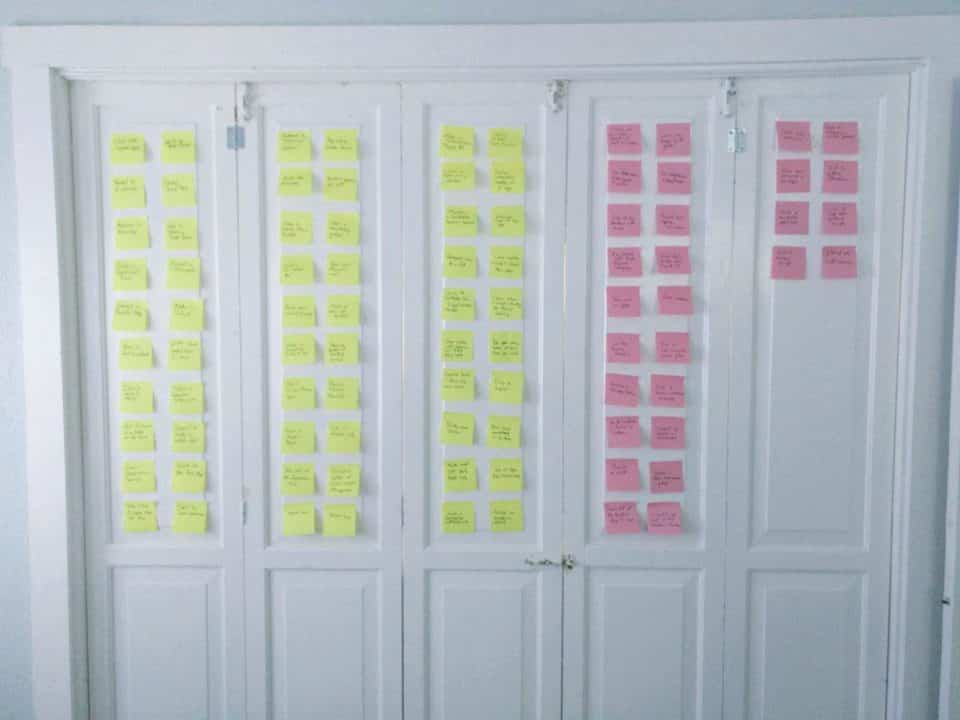
    Similar to the author, I spent my Saturday afternoon facing a blank wall (or set of retracting doors in my case), with a sharpie and stack of post-it notes in one hand, cup of coffee in the other. On a side note, I finally gave the Bulletproof Coffee concept a try, mixing coconut oil and butter into my hot coffee instead of milk or creamer. I can’t say it invigorated me as much as their sales hyperbole would claim, but it’s something that I’ll keep trying for a while.

    My goal was to get to 100 cards, each with a different goal on it. About every twenty cards or so I paused to refocus and think of what else I wanted to accomplish. I ended up making it to 88 cards in just over an hour, calling it there to reflect on what I’d come up with and to organize.

    Next: Organization

    I waited a few hours before organizing, glancing over the long list of my desires and wishes laid bare on my bedroom wall, put out of my mind and onto paper for the first time in my life. While the list is surely incomplete and a reflection only of current desires, it still looked imposing and monumental. At the same time, it brought a lightness to make them more manageable, short scribbles on small colored squares.

    I finally settled on ten categories that almost all of the cards could easily fit into: Teach, Learn, Create, Develop, Experience, Manage, Business, Public Life, Finance and Health. Grouping in this way made it a bit easier to see which concerns felt most pressing, and to find a common chain between related goals, such as recommitting myself to jogging and preparing to do half-marathons again. A lot of the learning related to creation or development, so those cards could naturally overlap as well.

    The final steps for me were to divide the cards even further into near-term goals (within the next six months), long-term goals, and ongoing goals. I then took the cards and uploaded them to a Trello board, ensuring that they wouldn’t get lost or lose their stick. Plus, I let my boyfriend read over them, but I’d probably be a bit overwhelmed if he and I saw them every day.

    My takeaway

    I’m attempting not to treat this activity as a once and over deal. I’m slowly moving through this list, making notes as to how I’d go about achieving these goals, and setting some plans into motion. Some of the areas that I identified as pressing was working on my delegation and streamlining of work, so I’ve put the call out for a managerial assistant, am searching for another virtual research assistant, and I’m setting up more general automation tasks.

    The point of all of this for me (and writing about it to you), is that I’m trying to consciously change and improve upon some behavior. I’ve often felt I’m working to no end in sight, and I imagine you have as well. Conscious self-reflection is prized in business – take stock in where you’ve been and where you’re going to make better choices. The way that the “personal brand” has taken center stage, we’re all businesses now. Why not pause to reflect on how we can improve the business of us?

    Do you take any time to self-reflect, or do you have plans to do so in the near future? Let me know below and maybe we can help one another!

🌙 ☀️